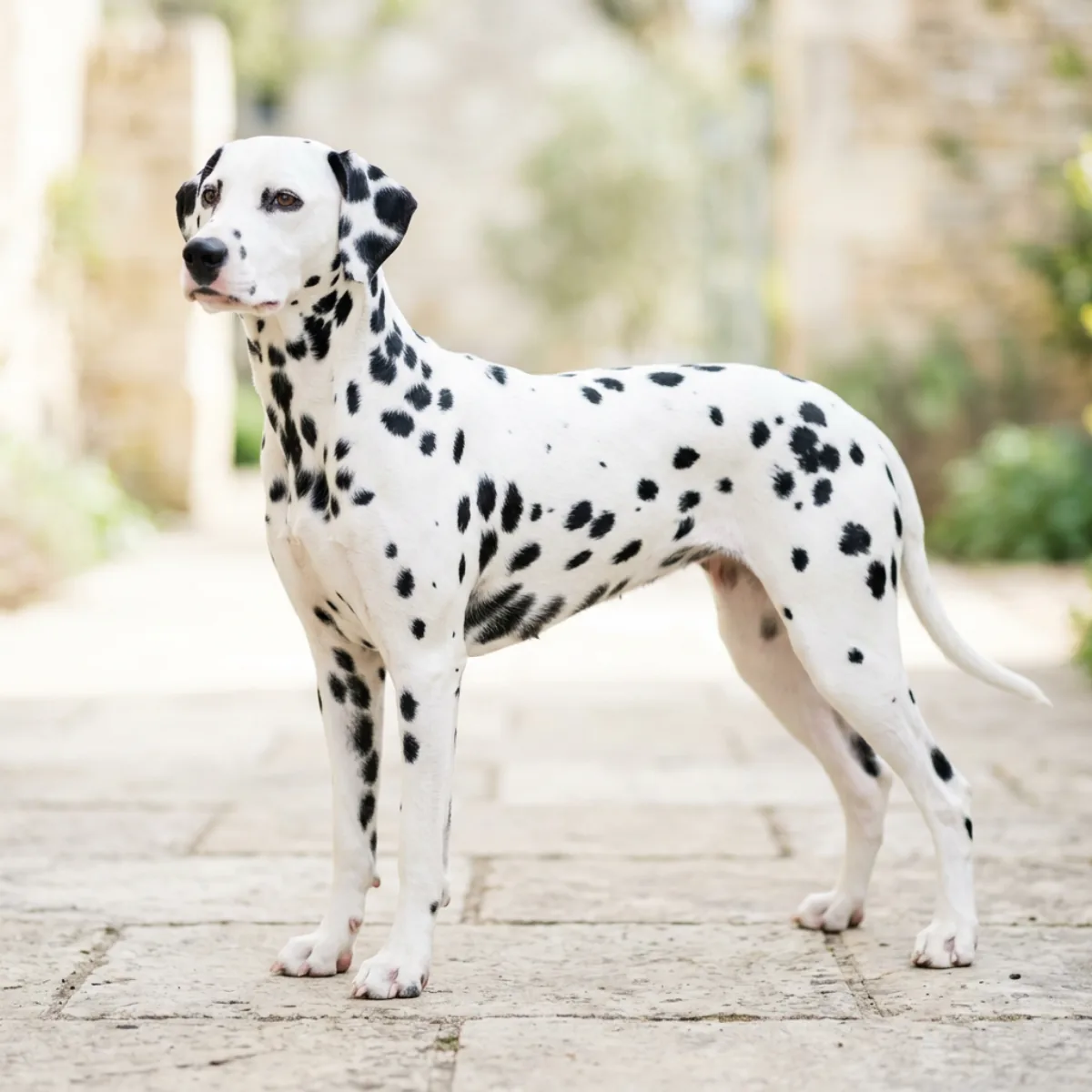
If you own a Dalmatian and you're trying to work out what's making them itch, you've been handed two sets of instructions and nobody has explained how they fit together. One says: run an elimination diet on a novel protein your dog has never eaten. The other says: feed low-purine, because Dalmatians form urate stones.
Those two mostly fit together — but not perfectly, and the place they rub is worth knowing. The proteins a vet reaches for in an elimination trial are game meats: kangaroo, venison, rabbit. Game sits a little above everyday muscle meat on purines, and Dalmatian feeding guidance commonly names game meats on the avoid list. That's not a reason to abandon the trial; it's a reason to pick the protein with your vet rather than straight off a list. The sharper cautions sit elsewhere — the treat drawer and the fish aisle.
The uric-acid difference is inherited, metabolic rather than immune, and essentially universal in the breed. A food sensitivity is a separate problem, and the one you can actually find by tracking. Your dog can have both — which is why you also track closely enough to tell an allergy itch from the bronze streaking linked to the uric acid. Those two look more alike than anybody tells you.
Two Different Food Problems in One Dog
Your Dalmatian runs two food stories at once; treating them as one wastes months and could even be dangerous.
Story one is immune — and it isn't one thing. A true food allergy is immediate and IgE-mediated, and uncommon in dogs. What most itchy dogs have is a food sensitivity: a delayed, non-IgE immune reaction surfacing days after the meal as itching, ear flares, chewed paws, sometimes gut upset. (Intolerance, the third category, isn't immune at all — an enzyme or chemical problem, digestive signs only.) Either way it's findable. The full taxonomy lives on telling a dog food allergy from a sensitivity.
Story two is metabolic. Almost every mammal finishes breaking down purines — building blocks in all animal tissue — by converting them to allantoin, which is soluble and simply leaves the body. Dalmatians don't. Research mapping the trait to SLC2A9 found that hyperuricosuria and hyperuricemia (huu) is a simple recessive trait for which all traditional Dalmatians are homozygous (Bannasch et al. 2008). In plain language: your dog excretes purine waste as poorly soluble uric acid — and poorly soluble waste in urine is how urate stones form. That's why a vet tells you to feed low-purine.
Story two is not an allergy, a sensitivity or an intolerance — it's a fourth category, present from birth and unchanged by any trial. You manage it by choosing foods, not by discovering triggers.
Breed decides much about where a food reaction lands — how a breed's build and genes decide where a food reaction shows up is the map. For the Dalmatian, the story isn't only anatomy — it's metabolism too.
The Second Constraint — and Where It Rubs Against the Usual Novel Proteins
Standard elimination advice says: feed a protein your dog's immune system has never met. The novel proteins we point people to across this site are kangaroo, venison, rabbit, horse, goat.
Now hold that against the purine question. Purine content isn't something you can read off a label, and we're deliberately not handing you a table of numbers: the figures circulating online come from human gout diets, not veterinary sources, and they disagree with each other two- to three-fold depending on whether they're quoted by weight or by portion. That isn't precision; it's the appearance of it. What survives across every source is the direction:
- Clearly higher: organ meat — liver especially — and other offal, far above ordinary muscle meat. Oily small fish — sardines, anchovies — sit up there too.
- A little above everyday muscle meat: game — kangaroo, venison, rabbit. Above beef, but far closer to beef than to liver, and not a tier of its own.
- Generally lower: lean white meats, eggs, dairy and most vegetables. (Dairy is the odd one out: fine on the metabolic side, but second on the all-dogs allergen list at about 17% — poor as a novel protein.)
Read those together and the honest shape is: the standard shortlist is game meat. All three sit modestly above everyday muscle meat — and, separately, Dalmatian guidance commonly puts game meats on the avoid list. That second thing isn't a measurement; it's a conservative call for a breed with no metabolic margin. Both are true at once, and the upshot is small: don't default to the shortlist — discuss it. Your vet knows your dog's urinary history and how tightly to restrict. Nobody is telling you the standard protocol backfires in a Dalmatian — only to choose the protein with someone who holds the rest of the picture.
The two cautions that are genuinely sharp
Oily small fish. Sardines and anchovies are a plausible novel-protein pick, and sit firmly in the higher direction. White fish is different — cod is usually placed well clear of the oily-fish end, though that comes from the same human tables.
Treats, toppers and training rewards. Most owners don't count these as "the diet". Liver is the default high-value training treat, and organ meat is the clearest thing in the higher direction. A trial can be immaculate at the bowl and still carry a daily organ-meat load from your pocket — dried liver treats, organ chews, a smear of pâté to hide a tablet. All of it counts, on both sides at once.
My own dog DJ has pancreatitis triggers, so his elimination work ran inside a fat-and-organ & stress restriction — when a medical dietary restriction complicates the picture covers that shape.
The Bronze Streak That Looks Like an Allergy
Some Dalmatians develop bronzing syndrome — "Dal crud" in kennel shorthand. The coat goes patchy and takes on a pink or bronze cast, usually across head and back; follicles inflame, become infected, and it itches. To an owner looking at a discoloured, scratching dog at 11pm, it reads as one thing: food allergy.
It probably isn't. Bronzing is described as a bacterial folliculitis — an infection of the hair follicles — and it appears to be linked to the breed's excessive uric-acid excretion rather than to any dietary protein. The caveat matters: not every Dalmatian gets bronzing, even though every traditional Dalmatian excretes excess uric acid. The link is associative, not causal, and the evidence base is breed-health databases and clinical handouts rather than peer-reviewed trials.
Bronzing is your vet's, not your elimination trial's. Diagnosis is clinical signs plus skin biopsy; management is vet-led — antibiotics and antiseptic shampoos, sometimes dietary modification or uric-acid-lowering medication. No diet clears it.
It's the cleanest illustration of why you track before changing the wrong thing. (The Shar-Pei's three overlapping itch drivers is the closest parallel here; the Husky is a different breed with a different non-food explanation.) Read bronze streaking as a chicken allergy and you'll lose twelve weeks for nothing.
Dalmatian Food Triggers: What a Real Food Reaction Looks Like
Dalmatians get food allergies the way dogs generally do. There's no credible figure saying the breed is over-represented — be sceptical of any page that gives you one. (Contrast why Labradors top every food-allergy list.) What the breed does have is a second explanation for skin signs. The immune-lane pattern:
- Itching at paws, belly, armpits, groin and ears — the thin-skinned, high-contact areas
- Recurring ear infections that clear on treatment and come straight back
- Paw licking, face rubbing and hot spots, worse at night
- Secondary yeast overgrowth on inflamed skin — musty smell, dark staining between the toes
- Gut signs in some dogs — loose stools, gas, unsettled appetite
Across all dogs, not this breed specifically, the most commonly implicated food proteins are beef (around 34% of confirmed adverse food reactions), dairy (about 17%), chicken (about 15%) and wheat (about 13%) (Mueller, Olivry & Prélaud 2016). A reasonable place to start looking — not a verdict on your dog.
And here's the piece that reframes everything you've tried: these reactions are delayed. Skin signs typically take days to appear after a trigger meal — a median of about five — and you need to watch up to 14 days to catch most reactors (Olivry & Mueller 2020). Sustained exposure appears cumulative: a small amount seems fine, a week of it doesn't. Full skin resolution after removing a trigger takes 8 to 12 weeks. If you've been judging foods by how your dog looked next morning, you were reading the wrong day. Itch with no fleas has plenty of competing explanations — none of which is a uric-acid-driven folliculitis.
HUA or LUA — Know Which Dalmatian You Have
The defect was corrected within the breed decades ago through the Dalmatian × Pointer backcross — outcross lines carrying a normal copy of the gene. Their descendants are registered as Low-Uric-Acid (LUA) Dalmatians alongside the traditional High-Uric-Acid (HUA) population (Bannasch et al. 2008), and handle purines normally.
Most Dalmatians you'll meet are HUA — but "most" isn't "all," and there's no reliable published figure for how much of the registered population is LUA, so don't let anyone quote one. If your dog came from a breeder, ask; otherwise a DNA test for the huu variant exists.
Running the Elimination Trial Alongside the Low-Purine Constraint
The general protocol isn't ours to re-teach — the one step that makes an elimination diet readable covers that. What follows is the Dalmatian-specific part.
- Pick the novel protein with your vet, not off a list. The usual shortlist — kangaroo, venison, rabbit — is three game meats: modestly above everyday muscle meat, and commonly named on Dalmatian avoid lists. That doesn't put them out of reach; it makes them a conversation instead of a default — a short one if there's no stone history, longer if there is. Oily small fish is the pick to be most careful with.
- Give it 8 to 12 weeks. Gut signs shift in a fortnight; skin is the slow one. Cutting the trial short at week three is the commonest way it fails.
- It's a diagnostic trial, not a treatment. An investigation with a planned end date — not a forever diet, not a cure. Reintroduction, one food at a time, watched for up to 14 days each, is where the answer arrives.
- No toppers — and that includes the treat drawer. Not pumpkin, cheese, broth, the corner of toast, the dried liver treats or the organ chew. Anything outside the protocol makes the window unreadable, and the organ-meat ones are the purine problem too.
The pillar on how a breed's build and genes decide where a food reaction shows up covers the anatomy side; the Dalmatian's metabolism tells you what else to watch for.
What to Track — and Which Signal Belongs to Which Lane
Sorting signals into lanes as you record them makes the log useful, not long.
Immune lane — yours to track, and findable:
- Itch score and location (paws, belly, ears, groin), daily
- Ear flares — redness, head shaking, odour, discharge
- Paw licking and chewing; stool quality and any vomiting
- Every meal, treat, chew and supplement, dated
Metabolic lane — your vet's, not something a food diary solves:
- Bronze or pink discolouration, patchy coat, follicular bumps
- Anything urinary at all
A pattern in the first list points at a food. A change in the second points at a phone call. Six weeks in, you'll have dates instead of "he's been scratching lately."
When to See Your Vet
Otherwise, book a normal appointment for:
- Skin lesions that don't resolve, or spread despite a clean trial
- Any sign of active infection — pus, crusting, hot painful patches, odour
- Ear infections that keep returning after treatment
- Bronze or patchy discolouration you haven't had examined
Diagnosis, stone management and any medication decision are veterinary calls.
Frequently Asked Questions
Do I have to avoid the usual novel proteins in a Dalmatian?
Not necessarily — but don't pick one without asking. Kangaroo, venison and rabbit are all game meats: modestly above everyday muscle meat, nowhere near organ meat, and named on Dalmatian avoid lists anyway, because the breed has no margin to spare. Both are true at once, which makes this a conversation with your vet, not a default pick. Organ meat and oily small fish are the clear higher direction; lean white meat, eggs and dairy the lower one — with the caveat that dairy is second on the all-dogs allergen list, so it makes a poor novel protein.
What about liver treats during the trial?
Liver is the one to think twice about — the default high-value training treat, and the clearest thing in the higher direction. Treats, chews, dental sticks and anything used to hide a tablet all count.
Is bronzing syndrome a food allergy?
No. Bronzing is described as a bacterial folliculitis that appears to be linked to the breed's excess uric-acid excretion rather than to a dietary protein — though not every Dalmatian develops it. Diagnosis and management are vet-led.
Do all Dalmatians need a low-purine diet?
Traditional Dalmatians are homozygous for the huu variant, so the difference is essentially universal in that population. The exception is the Low-Uric-Acid (LUA) backcross lines, which carry a normal copy of the gene — which is why "know your dog's status" is a real instruction. How tightly to restrict is your vet's call.
References
- Bannasch D, Safra N, Young A, Karmi N, Schaible RS, Ling GV. 2008. "Mutations in the SLC2A9 gene cause hyperuricosuria and hyperuricemia in the dog." PLoS Genetics, 4(11):e1000246. PMC2573870. DOI: 10.1371/journal.pgen.1000246.
- Mueller RS, Olivry T, Prélaud P. 2016. "Critically appraised topic on adverse food reactions of companion animals (2): common food allergen sources in dogs and cats." BMC Veterinary Research, 12:9. PMID: 26753610.
- Olivry T, Mueller RS, Prélaud P. 2015. "Critically appraised topic on adverse food reactions of companion animals (1): duration of elimination diets." BMC Veterinary Research, 11:225. PMID: 26310322.
- Olivry T, Mueller RS. 2020. "Critically appraised topic on adverse food reactions of companion animals (9): time to flare of cutaneous signs after a dietary challenge in dogs and cats with food allergies." BMC Veterinary Research, 16:158. PMID: 32448251. DOI: 10.1186/s12917-020-02379-3.
- University of Prince Edward Island. "Dalmatian bronzing syndrome." Canine Inherited Disorders Database.
- Purina Pro Club. "Research aims to determine the causes of urinary stones in Dalmatians."
Veterinary disclaimer: This article is for educational purposes only and does not constitute veterinary advice. Always consult with a qualified veterinarian before changing your pet's diet or discontinuing any prescribed treatments. Breed-specific sensitivities vary by individual dog; genetics, environment, and secondary conditions all shape what your pet reacts to. Persistent itching, ear infections, and skin irritation can have multiple causes — including environmental allergens, parasites, bacterial or yeast infections, and structural conditions — some of which require specific veterinary treatment. Persistent or severe symptoms should always be evaluated by a veterinary professional. This article does not replace a professional veterinary examination. If you observe signs of anaphylaxis, severe vomiting, collapse, or rapid deterioration, seek emergency veterinary care immediately.
Related Articles

Dog Breeds & Food Allergies: Anatomy Decides Where, Tracking Finds the Trigger
The pillar behind this page — how a breed's build and genes decide where a food reaction shows up, and why only a tracked trial names the trigger.
Read Article →
Husky Food Allergies — Or Is It Zinc? How to Tell the Three Skin Problems Apart
A different breed with a different non-food explanation — hereditary trouble absorbing zinc, which no elimination diet will touch.
Read Article →
The Dog Elimination Diet: How to Actually Track It
The full 8–12 week protocol referenced above — every failure point, and why the tracking is what makes the trial readable.
Read Article →