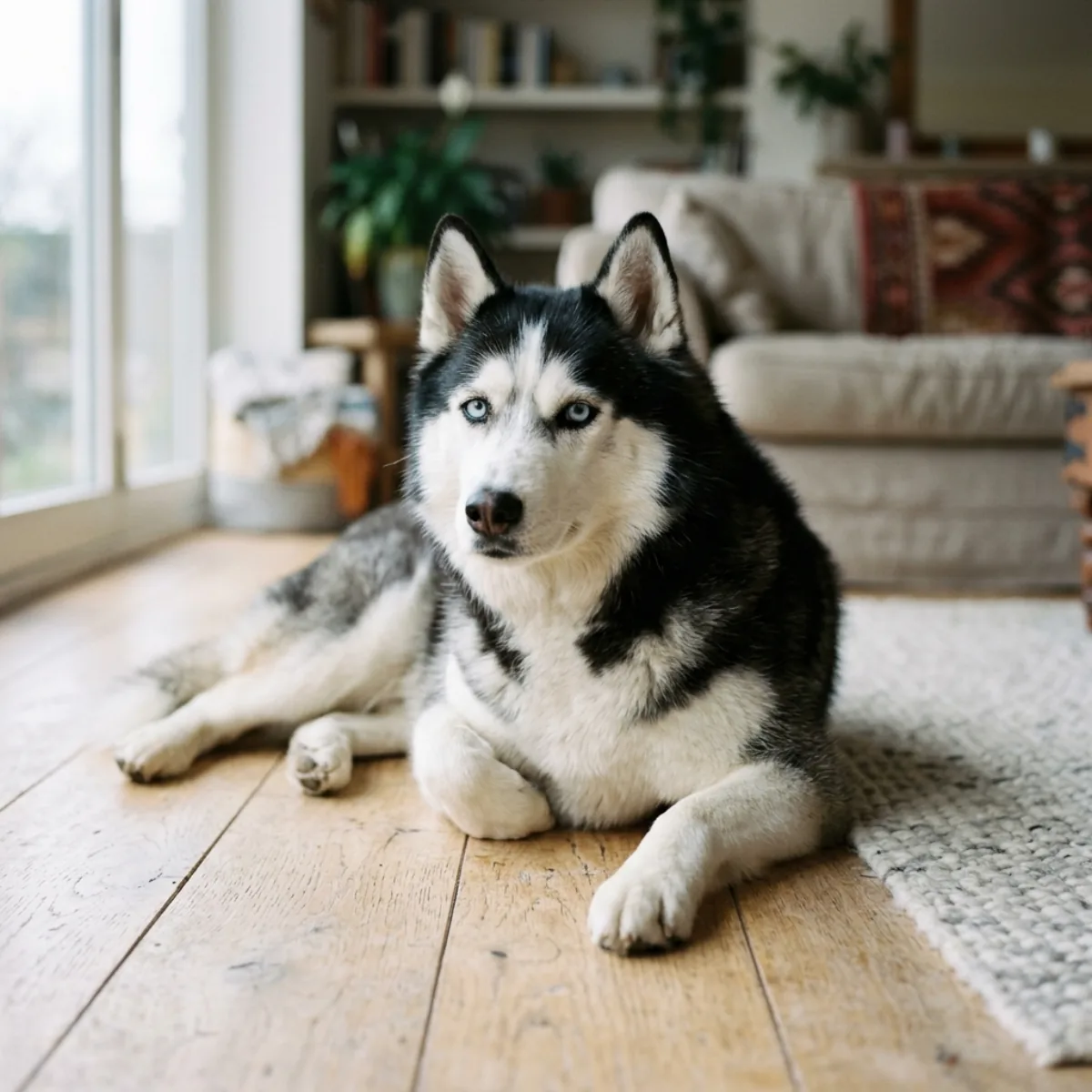
You changed the food. You paid for the limited-ingredient bag, you held the line for six weeks, and the crusts around your Husky's eyes and muzzle are still there. Most Husky-allergy articles will tell you to change the food again.
Here is the part they leave out: a Husky's skin trouble can come from three different places, and only one of them is food.
Nordic breeds — Siberian Huskies and Alaskan Malamutes above all — carry a hereditary difficulty absorbing zinc from the gut, and the skin condition that follows it develops even when the diet contains plenty of zinc. It shows up as crusting and scaling in specific places: around the eyes, on the muzzle and chin, on the footpads. It is not an allergy, an elimination diet will not fix it, and it is your vet's to diagnose and manage — not yours, and not ours.
A true food sensitivity looks different: itch at the paws, belly and ears, often with recurring ear infections. Environmental atopy looks different again.
Which is why the useful first move is not another bag of food. It is finding out which of the three you are actually dealing with — and food is the only one of the three you can test yourself.
Crusts Around the Eyes and Muzzle: The Husky Skin Problem That Isn't a Food Allergy
The condition has a name your vet may already have said out loud: zinc-responsive dermatosis. In plain language, the skin isn't building itself properly because it can't get enough working zinc — and zinc is what skin cells need to mature and shed normally. When that breaks down, the surface layer thickens into tightly stuck scale and crust instead of turning over quietly.
It's a fairly rare condition, but over-represented in exactly the breed you own. There are two recognised forms, and the difference between them is the single most useful thing here.
Syndrome I is the hereditary Nordic-breed form, and it occurs in dogs eating balanced, zinc-adequate food. Decreased intestinal zinc absorption has been identified in some Alaskan Malamutes, though the mechanism isn't fully worked out. The practical consequence: "but I already feed a premium food" does not rule this out. The food can be excellent and the dog can still not be absorbing what's in it.
Syndrome II is the diet-driven form — mostly rapidly growing puppies and young adults on diets that are genuinely zinc-deficient, or heavy in phytate and minerals. Different dogs, different problem.
The lesion pattern is what makes it recognisable: redness, partial-to-complete hair loss, and tightly adherent scale and crust around the eyes, across the muzzle, on the chin and lip margins, the ears, the footpads and the mucocutaneous junctions. Footpads can thicken and harden. In a published series of 41 cases, the Siberian Husky was the predominant breed affected and periocular crusts — crusting around the eyes — were the most common sign. Read the direction of that carefully: Huskies were common among dogs with this condition. It doesn't mean a given percentage of Huskies get it. Onset in the reported literature spans six months to ten years, with a large share developing lesions before age two — a literature range, not a prevalence rate.
Diagnosis isn't something you can do from a photo, and neither can we. It takes your vet: the signs, a skin biopsy, and the response to zinc given under veterinary direction. Please do not start zinc on your own. Over-supplementation carries a genuine toxicity risk and dosing is a veterinary decision. We won't put a number on this page, and you should be suspicious of any pet site that does.
Zinc, Food, or Pollen — and What Each One Actually Needs
One clarification first, because the table depends on it. A true food allergy is an immune reaction that tends to appear within hours; a food sensitivity is slower, dose-related, and builds over days. Most of what frustrates Husky owners sits at the sensitivity end — the full distinction is here.
How you identify them differs too, and that part is worth stating. For environmental allergy, intradermal skin testing is the veterinary gold standard. For food there is no equivalent — blood, saliva and hair tests sold for food sensitivity are not reliable, and an elimination trial with structured reintroduction is the only route to a trigger.
With that straight, here's the arrangement almost nobody offers a Husky owner — the three drivers side by side, with what each actually needs.
These are genuinely different diseases, not versions of each other. Zinc-responsive dermatosis responds to zinc, not to allergen removal; a food allergy responds to allergen removal, not to zinc. Treating one as the other is how people lose a year. (A Shar-Pei owner runs a similar three-way sort with a different third driver — skin folds rather than zinc absorption.)
Two honest caveats. Distribution is a first read, not a diagnosis — dogs are allowed to have more than one thing wrong at once. And secondary bacterial or yeast infection can sit on top of any of the three and add itch that muddies the picture. If your Husky is scratching and crusting, that itch may be coming from infection rather than the underlying driver — worth raising with your vet before you read anything into a food trial.
This is where the breed picture stops being enough. Our pillar explains how breed anatomy decides where a food reaction shows up — folds, ear canals, paws and bellies, dense coats. In a double-coated Nordic breed, it shows up late and hidden. But a Husky also carries a second, non-food route to the same-looking skin, which is why the breed picture alone is never the whole answer.
Why "Grain-Free" Didn't Help — and What the Label Doesn't Tell You
Almost every Husky owner reading this has already bought a grain-free bag — it's the reflex the pet food aisle trains you into. So here's the thing worth knowing. A "grain-free" claim tells you nothing about that food's zinc adequacy or availability. Grain-free is a statement about what was taken out, not about mineral bioavailability.
And availability is a real variable, separate from how much zinc is listed on the panel. Absorption is reduced by other dietary components — phytate and excess calcium in particular. Veterinary dermatology references note that diets high in calcium and phytate can precipitate zinc-responsive dermatosis by impeding zinc uptake in the gut; that's the classic driver of the diet-induced Syndrome II form.
Nobody has measured zinc status in dogs eating pulse-based grain-free food, so we'll go no further than the negative — and the negative is useful. Switching to grain-free tests a hypothesis about grains. It says nothing about zinc, so if zinc is what's actually driving the crusts, you can switch bags all year and watch nothing change.
And zinc is only half of what that label doesn't tell you. The plainer reason grain-free so often changes nothing: grain usually wasn't the problem. Wheat sits fourth among canine trigger proteins, behind beef, dairy and chicken — which between them account for roughly two-thirds, and at least one of which is almost certainly still in the grain-free bag. You removed the least likely suspect and kept the most likely ones.
What replaced it matters too. Grain-free formulas typically substitute pulses — peas, lentils, chickpeas — so the recipe usually gained ingredients rather than shedding them, and the processing is unchanged: same rendering, same palatants, same long list. Which is the lesson underneath all of it: switching bags is not a test. It moves several things at once and controls none of them. An elimination trial moves one thing deliberately, and that is the entire difference.
Husky Food Allergies: What a True Food Reaction Looks Like
Huskies get food allergies the way dogs generally get food allergies. We say that plainly because a lot of the pages ranking for this search imply the breed is unusually prone to them — and the sources making that claim are companies selling food, with no measured rate behind it. The Husky doesn't appear among the breeds that turn up repeatedly in the atopic dermatitis predisposition literature either. The breed-linked story here is the zinc one; the food story is the ordinary one.
Ordinary doesn't mean unimportant. It means it looks like it does in any dog:
- Itch concentrated at the paws, belly and ears
- Recurring ear infections, often in both ears
- Paw licking that starts as a habit and turns into a raw patch
- Hot spots that clear on medication and come back
- Non-seasonal — it doesn't clear when the pollen count drops
The trigger foods are the usual general-canine suspects in the usual order — beef, then dairy, then chicken, with wheat fourth — and those figures are across all dogs, not this breed (the full ranking, and why switching off chicken so often fails, is here). Useful as a starting hypothesis. Useless as an answer, because your dog is not a percentage.
Two Husky-specific complications.
The coat hides everything. A dense double coat means you often don't see the skin until the problem is well established — you feel a crust before you see one. It's the same trap a Golden Retriever owner falls into, where a dense double coat hides trouble until it's advanced. The difference: a Golden's story ends with coat density and moisture; a Husky's has a second chapter.
The reactions are delayed — the timings are in the table above (Olivry & Mueller 2020), and they are what breaks most home elimination attempts. Exposure works cumulatively: small amounts look fine, then a week of feeding pushes the dog past a threshold. Once the trigger is out, skin can take 8 to 12 weeks to settle. Reintroduce after three good days and see nothing, and you haven't cleared that food — three days is short of the median, let alone the 14-day window. (Telling a dog food allergy from a sensitivity covers that distinction properly; this page won't re-teach it.)
Running an Elimination Trial When a Second Thing Is Also Moving the Skin
An elimination trial works by holding everything steady except one variable. If a second, non-food driver is also moving the skin, the trial gets hard to read — not impossible, just hard. So you make the food arm as interpretable as you can.
The protocol itself is standard and lives elsewhere: a single genuinely novel protein, nothing else at all, 8 to 12 weeks, then structured reintroduction — and the step that actually makes it readable is the tracking, not the food choice. Breed anatomy decides where a reaction shows up, which tells you where to score daily on a double-coated dog — but not which of the three drivers is moving.
What changes when a zinc question is also in play:
- Run the vet lane in parallel. If your vet is investigating the crusting, let them — don't wait for a food trial to finish before raising it.
- Clear active infections before you start. Itch from a skin or ear infection contaminates the read no matter how disciplined your food log is.
- Score the two patterns separately. Track itch (paws, belly, ears) apart from crust and scale (eyes, muzzle, chin, pads). If itch drops and crusting doesn't, that's informative, not a failed trial.
- Photograph the face weekly — same light, same angle. Crusting changes slowly and your memory of it is unreliable.
- Change one thing at a time. If a vet-directed zinc plan starts mid-trial, note the date. You haven't ruined anything — you just need to know where the line is.
And the framing that matters most: an elimination trial is a diagnostic investigation with a planned end date, not a forever diet and not a treatment. The reintroduction isn't optional — it's the half where the answer lands.
What to Track — and What Tracking Can't Tell You
We'd rather be straight about the boundary than oversell it. Of the three drivers, tracking can speak to exactly one: food. That is still worth a great deal, because food is the one input you control completely and the one your vet can't observe. In practice: every meal, every treat, every chew, with a daily score for itch, ear signs, paw licking, stool and coat. Two minutes a day, until a pattern emerges that nobody could hold in their head.
What tracking cannot do: test zinc absorption, or measure pollen. It does not treat, cure, diagnose or prevent zinc-responsive dermatosis, atopy or anything else. Nobody's app can.
What it can do is change your next vet appointment. Walking in with 45 days of logged meals and daily skin scores is a different conversation from "he's been scratching a lot lately." My own Rottweiler, Shadow, took over nine months of that logging before the yeast and itch pattern resolved — and it resolved because the data made his tolerances visible protein by protein, not because we guessed better.
For causes outside food entirely, the wider list of reasons a dog scratches when fleas aren't the cause covers ground this page doesn't.
When to See Your Vet
Book an appointment — don't start a food trial first — if you see:
- Crusting or scaling around the eyes, muzzle, chin, ears or footpads, especially in a dog under three
- Thickened, hardened or cracking footpads
- Lesions that don't resolve, or keep returning in the same places
- Any sign of active infection: odour, discharge, pus, heat, rapid worsening
- Hair loss with adherent crust rather than simple thinning
- Loss of condition, poor appetite or lethargy alongside the skin signs
Bring your log and your photos. And ask directly whether zinc-responsive dermatosis is on the differential list — a reasonable question about a Siberian Husky, and a good vet won't mind you asking.
Frequently Asked Questions
Should I just give my Husky a zinc supplement?
No. That's a veterinary decision, not a shopping decision. Over-supplementation carries a real toxicity risk, the diagnosis needs confirming first — signs, biopsy, response to treatment — and the hereditary form usually needs ongoing veterinary management, not a bottle from the pet shop. If you suspect zinc-responsive dermatosis, tell your vet by name.
My Husky has crusty skin around the eyes. Is that a food allergy?
It might not be. Crusting and scaling around the eyes, muzzle, chin and footpads is the classic distribution for zinc-responsive dermatosis — in a published 41-case series the Siberian Husky was the predominant breed affected, with periocular crusts the most common sign. Food allergy more typically shows as itch at the paws, belly and ears with recurring ear infections. Treat distribution as a first read, not a diagnosis.
I already feed a premium, grain-free food. Doesn't that rule zinc out?
No, on both counts. The hereditary Nordic form develops in dogs eating balanced, zinc-adequate diets — the issue is absorption, not the label. And a grain-free claim tells you nothing about a food's zinc adequacy or availability; it only describes what was removed. Zinc uptake is separately reduced by dietary phytate and excess calcium.
How long should I run an elimination trial on a Husky?
Eight to twelve weeks on a single novel protein with absolutely nothing else, then structured reintroduction with up to 14 days of monitoring per challenge food. The double coat hides early skin change, so rely on daily scores and weekly photos rather than what you happen to notice. Treat it as a temporary investigation with an end date.
References
- White SD, Bourdeau P, Rosychuk RAW, Cohen B, Bonenberger T, Fieseler KV, Ihrke P, Chapman PL, Schultheiss P, Zur G, Cannon A, Outerbridge CA. 2001. "Zinc-responsive dermatosis in dogs: 41 cases and literature review." Veterinary Dermatology, 12(2):101–109. PMID: 11360336.
- Mueller RS, Olivry T, Prélaud P. 2016. "Critically appraised topic on adverse food reactions of companion animals (2): common food allergen sources in dogs and cats." BMC Veterinary Research, 12:9. PMID: 26753610.
- Olivry T, Mueller RS, Prélaud P. 2015. "Critically appraised topic on adverse food reactions of companion animals (1): duration of elimination diets." BMC Veterinary Research, 11:225. PMID: 26310322.
- Olivry T, Mueller RS. 2020. "Critically appraised topic on adverse food reactions of companion animals (9): time to flare of cutaneous signs after a dietary challenge in dogs and cats with food allergies." BMC Veterinary Research, 16:158. PMID: 32448251. DOI: 10.1186/s12917-020-02379-3.
- University of Minnesota. Small & Large Animal Dermatology Handbook, Vol. 2 — "Nutritional-related keratinization disorders: canine zinc-responsive dermatosis."
- Clinician's Brief. "Zinc-Responsive Dermatosis in Dogs: Diagnosing & Treating."
- MSD Veterinary Manual. "Atopic Dermatitis in Dogs."
Veterinary disclaimer: This article is for educational purposes only and does not constitute veterinary advice. Always consult with a qualified veterinarian before changing your pet's diet or discontinuing any prescribed treatments. Breed-specific sensitivities vary by individual dog; genetics, environment, and secondary conditions all shape what your pet reacts to. Persistent itching, ear infections, and skin irritation can have multiple causes — including environmental allergens, parasites, bacterial or yeast infections, nutritional and keratinization disorders, and structural conditions — some of which require specific veterinary treatment. Persistent or severe symptoms should always be evaluated by a veterinary professional. This article does not replace a professional veterinary examination. If you observe signs of anaphylaxis, severe vomiting, collapse, or rapid deterioration, seek emergency veterinary care immediately.
Related Articles

Dog Breeds & Food Allergies: Anatomy Decides Where, Tracking Finds the Trigger
The pillar behind this page — why a double coat hides a reaction that a floppy ear or a skin fold would have shown you weeks earlier.
Read Article →
Shar-Pei Food Allergies: Untangling the 3 Things Making Your Wrinkly Dog Itch
The same three-way sort with a different third driver — skin folds rather than zinc absorption. Only the food layer is yours to test.
Read Article →
The Dog Elimination Diet: How to Actually Track It
The full 8–12 week protocol referenced above — every failure point, and why the tracking is what makes the trial readable.
Read Article →