
If your Shar-Pei has been scratching, chewing at its paws, or trailing that musty, corn-chip smell for as long as you can remember, you've probably heard the same thing every time: "It's just the breed." That answer is half-true — and it's exactly why nothing has worked.
A Shar-Pei's itch usually isn't one problem. It's three, stacked on top of each other. There's the structural layer — the famous wrinkles, which come from a breed-defining genetic quirk that thickens and folds the skin into warm, moist creases where irritation thrives. There's the immune and atopic layer — Shar-Peis are prone to a form of immune deficiency and to environmental allergies that keep the skin inflamed and re-infecting. And there's the food layer.
Here's the part no "best food for Shar-Peis" list will tell you: two of those three drivers are fixed breed anatomy. You can't wrinkle-cream or antibiotic your way out of them. But the food layer is the one thing you can actually isolate and change — and this guide is about how to find it, by tracking.
Why a Shar-Pei's Itch Has Three Overlapping Causes — And Only One You Can Change
Most "best food for Shar-Pei" content treats itching as a single switch: change the bag, watch the itch disappear. For this breed, that framing sets owners up to fail, because it collapses three separate mechanisms into one.
- Structural — the wrinkle itself. Shar-Peis carry a genetic duplication that thickens the skin and drives the deep folds the breed is known for. Those folds trap moisture, friction, and debris, setting up chronic skin-fold dermatitis (also called intertrigo) whether or not food is involved.
- Immune / atopic — the breed is disproportionately prone to a form of selective IgA deficiency, plus the ordinary environmental atopy (pollen, dust mites, molds) that affects any dog. Both keep the immune system primed and the skin re-flaring.
- Food — a genuine adverse food reaction, immune-mediated or otherwise, layered on top of the other two.
The first two are baked into the dog's anatomy and immune wiring — you cannot diet your way out of a wrinkle or rewrite the breed's IgA profile. Food is the one variable you control, meal by meal, which is what makes it worth isolating instead of guessing at.
The Wrinkle Is Genetics, Not Food — HAS2, Mucinosis, and Skin-Fold Dermatitis
The wrinkle isn't incidental to the breed — it's the direct result of a single, well-characterized genetic mutation.
Shar-Peis carry an unstable duplication just upstream of a gene called HAS2 (hyaluronic acid synthase 2), which controls how much hyaluronan — a gel-like substance that gives skin its thickness and moisture — the body produces. The Shar-Pei duplication cranks that production up, creating the breed's signature thick, folded skin, a trait vets call cutaneous mucinosis. A higher copy number of the duplication is also linked to a greater risk of Familial Shar-Pei Fever, sometimes grouped today under the umbrella term Shar-Pei Autoinflammatory Disease (SPAID) — a periodic fever syndrome involving recurrent fever and swollen joints (Olsson et al. 2011).
The wrinkle is genetics, not diet — and it has a direct physical consequence: deep, tight folds create warm, moisture-trapped pockets of skin. That environment predisposes the breed to skin-fold dermatitis, a chronic surface irritation independent of the food bowl (UFAW, "Shar Pei — Skin Fold Dermatitis"). Those same fold sites are also where secondary problems tend to take hold — covered in the fold-to-hot-spot and fold-to-yeast sections below, with the full mechanism handed to two dedicated guides rather than re-taught here.
Boundary: SPAID and Familial Shar-Pei Fever are context for why this breed's skin behaves the way it does — not something food treats, manages, or prevents. Fever, swollen or painful joints, or other systemic signs mean a vet visit, not a tracking project (Cornell CVM, SPAID).
Why This Breed's Skin Keeps Re-Flaring — the IgA-Deficiency Angle
Owners of chronically itchy Shar-Peis often describe the same loop: antibiotics clear an infection, things improve for a few weeks, then it's back. Part of why has a documented immune basis.
IgA is an antibody that patrols mucosal surfaces — skin, gut lining, respiratory tract — as a first line of defense against everyday microbes. Dogs with low IgA have a thinner front line, so bacteria and yeast a normal immune system would keep in check get more opportunity to establish and re-establish infection. Foundational research found deficient serum IgA in roughly 77% (30 of 39) of clinically normal adult Shar-Peis across two research colonies — dogs with no outward disease (Moroff et al. 1986; Rivas et al. 1995). A later, larger multi-breed screen confirmed the Shar-Pei as one of several breeds genetically predisposed to low serum IgA (Olsson et al. 2014).
This reframes the "why does it keep coming back" question: it isn't necessarily that food is causing repeat infections, or that fold care is done wrong. Many Shar-Peis have a thinner immune front line at the exact sites where the wrinkles already favor organisms taking hold — fixed, breed-associated, not something a food swap resolves.
Same boundary as above: this context explains why the skin re-infects — it's not a food-fix claim or a home diagnosis, and not a reason to keep cycling antibiotics without a vet re-checking the underlying picture.
How to Tell Food From the Wrinkle and the Atopy
This is the actual disentanglement — the part a listicle can't give you, because it requires watching your own dog over time, not switching bags.
Location and pattern. Structural skin-fold dermatitis shows up at fold sites — facial wrinkles, tail pocket, sometimes neck and body folds — largely regardless of diet. If irritation is confined to those creases and tracks with humidity, heat, or how recently folds were cleaned, that points structural.
Seasonality. Environmental atopy waxes and wanes with pollen counts, humidity, and time of year — flares clustering in spring or after a weather change, independent of feeding, point toward the atopic layer.
Timing against meals. Food-driven reactions are the one driver with a predictable — if delayed — relationship to eating. Cutaneous reactions to a trigger food in dogs typically appear within 1 to 14 days, median around 5 days; capturing the full picture takes a monitoring window of up to two weeks per food (Olivry & Mueller 2020). That delay is why most owners miss the pattern without writing it down — a flare on Thursday doesn't obviously connect to the plate the previous weekend.
What generalized, non-seasonal itching suggests. Itching outside the fold sites that doesn't track with season and seems to shift a few days after diet changes is the signal worth logging systematically — the whole point of tracking rather than guessing.
Surfacing that food-symptom pattern — especially the delayed kind — is exactly what consistent tracking does. Logging meals and symptoms side by side turns "it flares sometimes" into a dated, visible pattern you and your vet can act on. The food layer is the one you get to change; tracking is how you find out whether it needs changing at all.
Common Food Triggers in Shar-Peis
There is no reliable, breed-specific food-allergy prevalence figure for Shar-Peis published anywhere — any article that gives you one is making it up. What we do have is the general canine allergen picture from a systematic review of adverse food reactions: beef accounts for roughly 34% of confirmed reactions, dairy about 17%, chicken about 15%, and wheat about 13%, with lamb, soy, corn, and egg making up smaller shares (Mueller, Olivry & Prélaud 2016). And among dogs with skin disease, food reactivity is only one contributor alongside environmental atopy and flea allergy — which is why isolating the food layer matters.
None of this is Shar-Pei-specific — it's the general canine ranking, applying here the same way it applies to any breed. The point isn't to memorize percentages; it's that beef, dairy, and chicken are reasonable places to start looking, not proof of what your specific dog reacts to.
The Fold-and-Yeast Connection
Skin folds trap moisture and create a microclimate that yeast (usually Malassezia) and bacteria find hospitable, and inflammation from any of the three drivers above can tip it toward overgrowth. We won't re-teach that cascade here; our yeast infections and food guide covers the fold-to-Malassezia mechanism in full. Fold sites are also a common hot spot location once the skin barrier is compromised — fold hygiene and food tracking work together, not as substitutes.
Why "Best Food for Shar-Peis" Switching Can't Find Your Dog's Trigger
Every listicle promising the "best food for Shar-Pei allergies" makes the same implicit claim: that a single formula works for the breed. There isn't one — the itch has three separate causes, and a bag of food can only ever touch one of them.
Switching blind has a deeper problem: it doesn't isolate anything. Improvement could be the new protein, removing the old one, a coincidental fold-care improvement, or a seasonal dip in atopic symptoms. No improvement could mean food was never the driver, or that you were chasing a structural or immune-driven flare the whole time. Without a record of what changed and when, a switch tells you almost nothing you can act on with confidence.
The Elimination Trial: A Diagnostic, Not a Treatment
If food is a live suspect once you've weighed the pattern differences above, the tool that isolates it is a structured elimination trial — not another bag swap. An elimination trial is a diagnostic test, not a treatment: it answers whether a specific food is contributing to symptoms, by removing suspect ingredients and reintroducing them one at a time while watching for a reaction.
We've written the full mechanics — protocol length, novel-protein selection, reintroduction sequence — in our dog elimination diet and tracking guide, so we won't repeat it here. For a Shar-Pei specifically: the trial only tells you about the food layer. It won't touch the structural fold issue or the immune-driven atopy — those need their own management, alongside your vet, regardless of what the trial finds.
What to Track
Whether or not you run a formal elimination trial, the habit that disentangles these three drivers is consistent logging. For a Shar-Pei, that means recording:
- Food — every meal, treat, and chew, including brand and protein source
- Symptoms — itching, redness, odor, and location (fold sites vs. elsewhere)
- Fold condition — how clean and dry the folds are that day, tracked separately from symptom severity so you're not conflating hygiene with diet
- Timing — the date of any new food and any flare, logged separately so you can check the gap
- Delayed reactions — skin reactions can take up to two weeks to appear, so don't rule a food out too early
Over a few weeks, that record separates the fold-linked and seasonal flares that won't move with diet from the ones that do.
When to See Your Vet
Some signs belong with a vet, not a tracker. See your veterinarian if you notice:
- Broken skin, discharge, or strong odor at fold sites — signs of active skin-fold dermatitis or secondary infection needing topical or systemic treatment
- Fever, swollen or painful joints, or other systemic signs — possible SPAID/Familial Shar-Pei Fever indicators requiring veterinary evaluation, not a diet change
- Symptoms worsening, spreading, or not responding to fold hygiene
- Any sudden, severe reaction — facial swelling, vomiting, or collapse — needing emergency care immediately
How This Guide Differs from Our French Bulldog, Labrador & GSD Breed Guides
Our French Bulldog guide covers facial-fold care specific to brachycephalic anatomy — a different fold mechanism than the body-wide HAS2/mucinosis wrinkle here. Our Labrador and German Shepherd guides cover those breeds' own triggers and immune quirks. This guide owns the Shar-Pei's combination — HAS2/mucinosis, SPAID context, IgA-deficiency predisposition, layered against the food question — not fold-care basics or elimination-protocol mechanics, which live in the linked guides above.
Frequently Asked Questions
Is my Shar-Pei's itching caused by food, or is it just "the breed"?
Often both. The wrinkle-driven skin-fold dermatitis and the breed's immune predisposition are fixed anatomy. Food can be a genuine third contributor layered on top — tracking symptoms against meals and fold condition over a few weeks is how you find out.
Can changing my Shar-Pei's food cure SPAID or IgA deficiency?
No. Diet does not treat, cure, or prevent SPAID or IgA deficiency — both are genetic, breed-associated conditions requiring veterinary diagnosis and management. Tracking can identify a separate, modifiable food-driven contributor to itching, but it isn't a treatment for either.
What's the difference between a food allergy and a food sensitivity?
A true allergy involves an immediate immune response (IgE-mediated); a sensitivity involves a delayed response that can take days. Most of what owners notice — itching, ear or skin flares days after a meal — fits the delayed-sensitivity pattern, which is exactly why tracking matters.
What are the most common food triggers in dogs?
Beef, dairy, chicken, and wheat are the most frequently implicated ingredients across confirmed canine adverse food reactions, in roughly that order. There's no Shar-Pei-specific version of this ranking — it's a starting point for what to watch, not a diagnosis.
How long should I track before drawing conclusions about a food?
Because skin reactions to food can take up to two weeks to appear, watch each food for at least that long before ruling it in or out. A single clean week isn't enough data — consistent logging across several weeks reveals a real pattern versus coincidence.
References
- Moroff SD, Hurvitz AI, Peterson ME, Saunders L, Noone KE. 1986. "IgA deficiency in shar-pei dogs." Veterinary Immunology and Immunopathology, 13(3):181-188. PMID: 3798733.
- Olivry T, Mueller RS. 2020. "Critically appraised topic on adverse food reactions of companion animals (9): time to flare of cutaneous signs after a dietary challenge." BMC Veterinary Research, 16:168. PMID: 32448251.
- Olsson M, Meadows JRS, Truvé K, et al. 2011. "A Novel Unstable Duplication Upstream of HAS2 Predisposes to a Breed-Defining Skin Phenotype and a Periodic Fever Syndrome in Chinese Shar-Pei Dogs." PLOS Genetics, 7(3):e1001332. PMID: 21437276.
- Olsson M, Frankowiack M, Tengvall K, et al. 2014. "The dog as a genetic model for immunoglobulin A (IgA) deficiency: identification of several breeds with low serum IgA concentrations." Veterinary Immunology and Immunopathology, 160(3-4):255-259. PMID: 24935667.
- Rivas AL, Tintle L, Argentieri D, Kimball ES, Goodman MG, Anderson DW, Capetola RJ, Quimby FW. 1995. "A primary immunodeficiency syndrome in Shar-Pei dogs." Clinical Immunology and Immunopathology, 74(3):243-251. PMID: 7859414.
- Mueller RS, Olivry T, Prélaud P. 2016. "Critically appraised topic on adverse food reactions of companion animals (2): common food allergen sources in dogs and cats." BMC Veterinary Research, 12:9. PMID: 26753610.
- Cornell University College of Veterinary Medicine, Animal Health Diagnostic Center. "Shar-Pei Autoinflammatory Disease (SPAID)."
- Universities Federation for Animal Welfare (UFAW). "Shar Pei — Skin Fold Dermatitis."
Veterinary disclaimer: This article is for educational purposes only and does not constitute veterinary advice. Always consult with a qualified veterinarian before changing your pet's diet or discontinuing any prescribed treatments. Persistent itching, ear infections, and skin irritation can have multiple causes — including environmental allergens, parasites, bacterial or yeast infections, and structural conditions such as skin-fold dermatitis with secondary infection — some of which require specific veterinary treatment. Breed-specific sensitivities vary by individual dog; genetics, environment, and secondary conditions all shape what your pet reacts to. Persistent or severe symptoms should always be evaluated by a veterinary professional. This article does not replace a professional veterinary examination. If you observe signs of anaphylaxis, severe vomiting, collapse, or rapid deterioration, seek emergency veterinary care immediately.
Related Articles
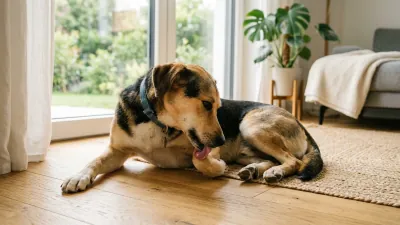
Dog Yeast Infections and Food: Why It Keeps Coming Back
Recurrent yeast in the ears, paws or folds is rarely a skin problem alone. Here's the diet-to-yeast chain, and how to find what's feeding it.
Read Article →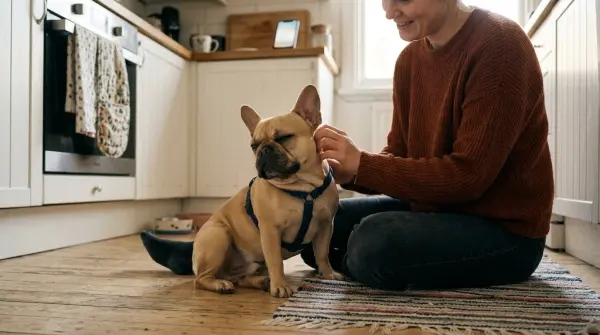
French Bulldog Food Allergies: The Fold-and-Food Picture
A different fold mechanism to the Shar-Pei's, with its own care routine. What brachycephalic anatomy changes about finding the trigger.
Read Article →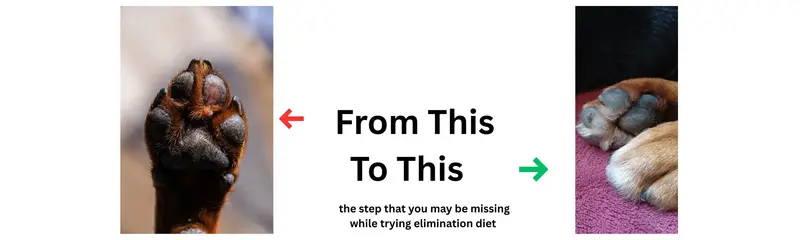
The Dog Elimination Diet: How to Actually Track It
The 8–12 week protocol, every failure point, and how structured tracking turns a long trial into a readable answer.
Read Article →