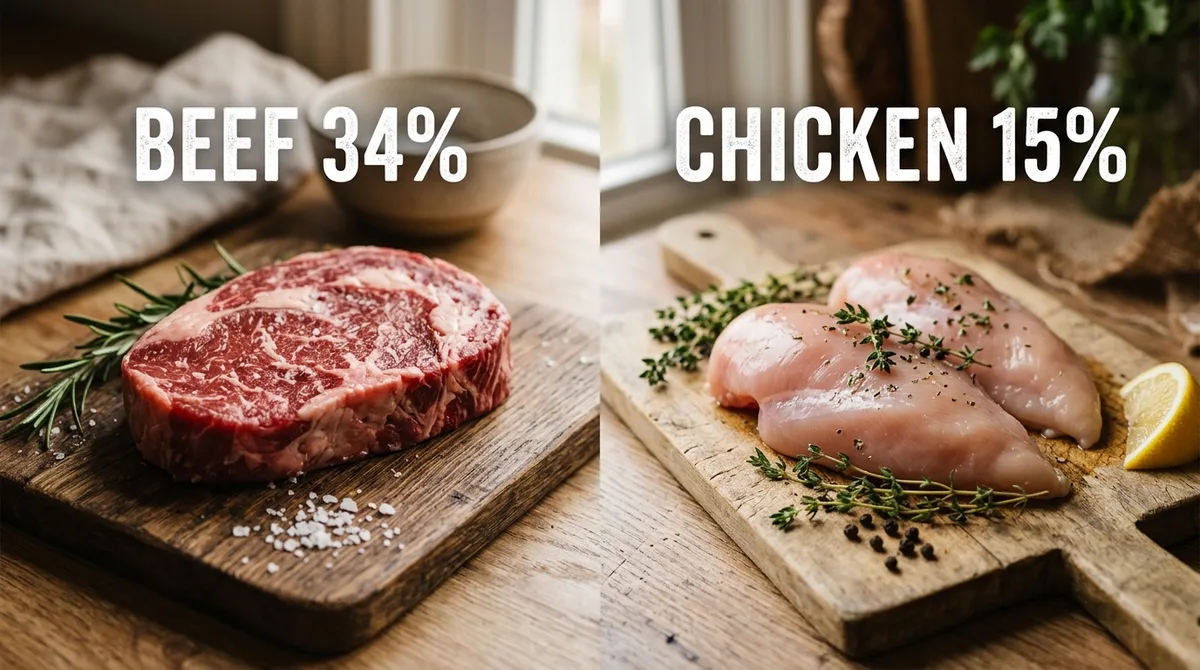
You did the responsible thing. Your dog was itching, scratching, getting ear infections that wouldn't quit — and you went looking for answers. Everything you found said the same thing: chicken is the number one food allergen in dogs. So you switched to a chicken-free formula. Maybe you spent $60 or $70 on a bag of premium chicken-free kibble. You waited. You watched.
And your dog is still itching.
It's not because you did something wrong. It's because the advice was wrong. The "chicken is the biggest problem" claim has been repeated so many times across breed blogs, pet store aisles, and social media that it feels like established fact. But when you look at the peer-reviewed research — the actual data from veterinary studies — a very different picture emerges. One where chicken isn't even close to the top of the list.
Something in your dog's food is likely driving these symptoms. But there's a good chance you've been eliminating the wrong protein and leaving the real trigger sitting in the bowl.
A quick note on terminology: You'll see "food allergy" everywhere online, and we use the term in our headings because that's what most people search for. But true food allergies — immediate immune reactions like hives or facial swelling — are rare in dogs. What most dogs experience are food sensitivities: delayed immune responses that show up as itching, ear infections, gut problems, and skin inflammation hours or days after eating a trigger food. Throughout this article, we'll use "sensitivity" and "trigger food" for accuracy, and "allergy" where it reflects common usage or appears in research citations.
The Chicken Myth — Where It Came From
If you search "most common dog food allergen" right now, you'll find dozens of breed blogs, pet advice sites, and social media posts claiming chicken tops the list. Pet store employees repeat it. Breeders warn about it. Entire product lines are built around "chicken-free" as a selling point. The message is consistent enough that questioning it feels contrarian.
But where did it start?
Part of the answer is visibility. Chicken is the single most common protein in commercial dog food. It's in kibble, wet food, treats, dental chews, training rewards, and supplements. If a dog develops food sensitivity symptoms, and the owner checks the ingredient list, chicken is almost always there. It's the easiest protein to point a finger at — not because the evidence says it's the most common trigger, but because it's the most common ingredient.
The "grain-free" marketing wave amplified this. As grain-free diets surged in popularity, brands needed a next-level differentiation story. "Chicken-free" became that story — a way to signal premium quality and allergen awareness, regardless of what the research actually supported.
Social media did the rest. One confident post claiming "chicken is the #1 dog food allergen" gets shared, screenshotted, and repeated until it becomes received wisdom. Nobody checks the citation because there's nothing to check — the claim didn't come from a study. It came from repetition.
The problem isn't that chicken can't be a trigger. It absolutely can. The problem is that calling it the most common trigger isn't what the research shows — and building your dog's entire dietary strategy around that claim may mean you've been solving the wrong problem.
The Real Numbers — What Peer-Reviewed Research Found
In 2016, Mueller, Olivry, and Prélaud published a systematic review in BMC Veterinary Research — a meta-analysis that pooled data from multiple clinical studies to identify which food proteins most commonly triggered adverse reactions in dogs. It remains the most widely cited study on canine food sensitivity prevalence, and it covered data from dogs with confirmed adverse food reactions across multiple clinical studies.
Here's what they found:
| Protein | % of dogs with food sensitivities |
|---|---|
| Beef | 34% |
| Dairy | 17% |
| Chicken | 15% |
| Wheat | 13% |
| Soy | 6% |
| Lamb | 5% |
| Corn | 4% |
Read that again. Beef causes more than twice as many food reactions as chicken. Not slightly more. Not a marginal difference. More than double.
And dairy — a sensitivity trigger that almost nobody talks about in the pet food world — is more common than chicken too. At 17%, dairy sits quietly in second place, virtually absent from the breed blogs and pet store conversations that spend all their time warning about chicken.
A critical note: these are percentages of dogs with food sensitivities, not all dogs. Most dogs tolerate all proteins just fine and will never develop food sensitivities. But among those that do react, the hierarchy is clear — and it's not what the internet has been telling you.
Here's why this matters in practical terms. If your dog is itchy and you switch from a chicken-and-rice kibble to a beef-based, chicken-free formula, you've removed a protein responsible for 15% of food reactions — and replaced it with one responsible for 34%. You haven't just failed to solve the problem. You may have made it worse.
And if your dog's dental chew contains dairy derivatives (more on that in a moment), you've introduced a 17% trigger on top of the 34% one. The "chicken-free" switch didn't just miss — it moved in the wrong direction entirely.
This is not opinion. This is the largest peer-reviewed dataset we have on canine food sensitivity prevalence (Mueller et al., 2016). And it tells a fundamentally different story than the one circulating across pet advice platforms.
But Not Every Breed Is Average
These Mueller et al. percentages are population-wide averages across 297 dogs spanning many breeds. Your dog's breed may sit materially above or below any of these numbers — especially for chicken, which breed-specific tracking data shows is highly variable.
A few patterns worth knowing (note: breed-specific figures below are directional estimates from non-peer-reviewed tracking databases, not peer-reviewed prevalence studies — treat them as "your breed is probably closer to this than to the Mueller average," not as precise rates):
- French Bulldogs may see chicken reactions closer to ~60% of their food-sensitivity cases (well above the 15% Mueller baseline), with beef and dairy also common — and the same non-peer-reviewed tracking data suggests similar chicken-skew in several related breeds. See why chicken matters more for Frenchies and what actually helps for the full breakdown including what this means for other sensitivity-prone breeds.
- West Highland White Terriers have the highest documented atopic dermatitis rates of any breed (~52% by age 3), with significant overlap between food and environmental sensitivities. See Westie food sensitivities and the 50% overlap most vets miss.
- Golden Retrievers don't have published breed-specific % breakdowns, but their dense double coat and atopic predisposition make delayed food reactions especially hard to spot without tracking. See why your Golden is scratching.
The generic Mueller figures are still useful — they tell you where to START. Your breed's data tells you where to LOOK FIRST. Your individual dog's tracking tells you the actual answer.
The Dairy Blind Spot — The Allergen Hiding in Plain Sight
If beef being number one surprises you, dairy being number two might be even more unexpected. At 17% of adverse food reactions in dogs, dairy proteins are more commonly implicated than chicken — yet dairy almost never appears in conversations about dog food sensitivities.
Part of the reason is that dairy doesn't look like dairy in most pet products.
Casein and whey — the two main protein groups in milk — show up in places you wouldn't think to check. They're not listed as "dairy" on the label. They appear as:
- Dental chews. Many popular dental sticks use milk-derived calcium or casein as binding agents. If your dog gets a dental chew every night before bed, that's a daily dose of dairy protein on top of whatever their food contains.
- Supplements and joint chews. Cheese-flavored glucosamine chews, probiotic supplements with whey-based carriers, and "natural flavoring" that derives from dairy sources.
- Pill pockets. Those soft treats designed to hide medication often contain dairy proteins for palatability and texture.
- Training treats. Cheese-flavored or yogurt-coated treats are obvious, but even plain-looking training rewards may list whey or casein in the fine print.
The practical impact of this blind spot is devastating for elimination diets. Picture this: you've done everything right. You've put your dog on a limited-ingredient, novel-protein diet. You're carefully avoiding chicken and beef. You're eight weeks in, tracking progress. But every night, you hand your dog a dairy-based dental chew — and the elimination diet is broken. The symptoms never fully resolve, and you conclude that the diet "didn't work."
It did work. The dental chew undid it.
This is one of the most common reasons elimination diets fail in practice, and it's almost never discussed. If your dog is on any kind of restricted diet, every single thing that goes into their mouth needs to be checked — not just the food in the bowl. Treats, chews, supplements, flavored medications, and even toothpaste can contain dairy derivatives that keep the immune response simmering.
Why "Chicken-Free" Food Often Doesn't Work
If you've already tried chicken-free food and your dog is still symptomatic, you're not alone — and it doesn't mean dietary management is hopeless. It usually means one of four things went wrong.
The real trigger stayed in the bowl. If your dog reacts to beef (34% probability) or dairy (17%), switching to chicken-free changes nothing. Many chicken-free formulas use beef as their primary protein. Others contain dairy derivatives. You removed a 15% probability trigger and left higher-probability triggers untouched.
"Chicken-free" doesn't mean "limited ingredient." A chicken-free label means exactly one thing: no chicken. The formula may still contain beef, dairy, wheat, soy, lamb, egg, and a dozen other proteins. Unless the food is a true single-protein, limited-ingredient diet, you're still feeding multiple potential triggers simultaneously — making it impossible to identify which one (or which combination) is the problem.
The food may not contain what you think it does. PCR-based DNA testing of commercial pet foods has revealed a significant mislabeling problem. Willis-Mahn et al. (2022) found chicken DNA in approximately 65% of dry dog foods tested — including products that don't list chicken as an ingredient. Horvath-Ungerboeck et al. (2017) found similar undeclared proteins in commercial elimination diets. This isn't about deception from manufacturers; cross-contamination during processing is common. But for a dog with food sensitivities, undeclared proteins can silently sabotage an elimination diet.
Delayed reactions hide the connection. Food sensitivity reactions in dogs don't happen immediately. Research shows a median onset of approximately 5 days for cutaneous signs after a food challenge (Olivry & Mueller, 2020), and cumulative skin and itch effects can build across days or even weeks. When you switch food and your dog is still itching a week later, it's easy to conclude the new food isn't helping. But you might be seeing the tail end of the old food's reaction, not a reaction to the new one. Without tracking, you can't tell the difference.
These four factors create a frustrating cycle: switch food, see brief improvement (often a novelty effect), symptoms return, conclude the new food "didn't work," switch again. Repeat indefinitely. The problem was never the approach — it was the lack of data to guide it.
Pet Health Quiz
Allergy or Sensitivity? Take the 60-second quiz.
12 quick questions about your pet’s symptoms. You’ll see what your answers point to — allergy, sensitivity, or both — and what to do next.
Take the QuizThe Breed Exception — When Chicken IS the Problem
Everything above reflects population-level data — averages across all breeds. And population data is the right starting point. But it's not the whole story.
Breed-specific patterns exist, and for some breeds, chicken may genuinely be a more significant trigger than the overall 15% figure suggests.
French Bulldogs are the most commonly cited example. Breed-specific sources and veterinary dermatology practices report higher rates of chicken sensitivity in Frenchies than the general population. While peer-reviewed breed-specific trigger data for French Bulldogs is limited, the clinical pattern is consistent enough that many veterinary dermatologists start Frenchie elimination diets by removing chicken alongside beef and dairy. If you have a French Bulldog, our complete guide to Frenchie food sensitivities covers the breed-specific nuances in depth.
Labradors are another breed where some reports suggest elevated chicken sensitivity — with some non-peer-reviewed sources citing rates around 40%. Again, this figure should be treated with caution: it comes from clinical observations and breed-specific databases rather than controlled studies. But it's worth knowing if you have a Lab.
Westies (West Highland White Terriers) have their own distinct sensitivity profile, with skin-related food reactions being particularly prevalent in the breed. See our Westie food sensitivity guide for breed-specific recommendations.
Here's the critical point: population statistics give you starting probabilities. They tell you where to look first. But they don't tell you what YOUR dog reacts to. A Labrador might tolerate chicken perfectly well despite the breed's elevated rates. A mixed breed might be in the 15% that doesn't.
Breed data guides which protein to test first in an elimination diet. Tracking confirms whether the test was right. One gives you a hypothesis. The other gives you an answer.
Multi-Allergen Dogs — Why Single-Protein Switches Fail
Here's something that doesn't get discussed enough: many food-sensitive dogs react to more than one protein.
If your dog reacts to both chicken and beef — which isn't uncommon given that those are the two most prevalent proteins in commercial dog food — then switching from one to the other accomplishes nothing. You've traded one trigger for another. The symptoms continue, and you're left wondering why dietary management "doesn't work for your dog."
It does work. But single-protein switches between common proteins aren't elimination diets — they're lateral moves.
The only reliable approach for dogs with multiple food sensitivities is a true elimination diet using a novel protein: a protein source your dog has never been exposed to. Venison, kangaroo, rabbit, or duck (if your dog hasn't eaten duck-based food before) are common novel protein choices. Hydrolyzed protein diets — where proteins are broken down small enough that the immune system doesn't recognize them — are another option, though they come with their own complications (see our hydrolyzed elimination diet guide for the full picture).
Once symptoms resolve on the novel protein (which typically takes 8 to 12 weeks for full skin symptom resolution), the next step is controlled reintroduction. You add back one protein at a time — beef first, since it's the most common trigger — and track symptoms daily for up to 14 days per protein. This is the only way to build a reliable map of your individual dog's triggers.
It's slow. It's methodical. And it's the only approach that actually produces answers rather than guesses.
The Only Way to Know — Elimination + Tracking
You've probably seen ads for dog food allergy blood tests or saliva tests. They promise to identify your dog's triggers from a single sample — no elimination diet needed. The appeal is obvious. Who wouldn't want to skip eight weeks of restricted feeding?
The problem is that food sensitivities in dogs are generally not IgE-mediated — they don't involve the same immune pathway that blood and saliva tests measure. Multiple veterinary dermatology studies have found that these tests produce high rates of false positives and false negatives for food-related reactions. The gold standard, according to veterinary consensus, remains the elimination diet with controlled reintroduction.
Population data — the Mueller et al. percentages, the breed-specific patterns — gives you probabilities. It tells you where the odds are. But probabilities don't diagnose your individual dog. Only systematic observation does.
Here's the protocol that works:
- Start with a novel protein. Choose a protein your dog has never eaten. Feed nothing else — no treats, no dental chews, no flavored supplements — unless they're made from the same single protein source. This is where most elimination diets fail: not the food in the bowl, but everything around it.
- Maintain the elimination phase for 8 to 12 weeks. Skin symptoms are slow to resolve. It takes time for existing inflammation to calm down, for skin cell turnover to complete, and for the immune system to stop producing the inflammatory signals that drive itching. Two weeks isn't enough. Four weeks isn't enough. Eight is the minimum for most dogs, and twelve gives a clearer picture.
- Track daily. This is the step that separates diets that produce answers from diets that produce frustration. Log every meal, every treat, every symptom, every behavior change — daily. Food sensitivity reactions in dogs typically take days to appear — with a median of about 5 days for skin signs — and cumulative effects can build across days or weeks. You cannot track delayed reactions by memory. By day five of an elimination diet, you've already forgotten what happened on day one.
- Reintroduce one protein at a time. Once symptoms have resolved (or significantly improved), add back a single protein. Monitor for up to 14 days. If symptoms return, you've identified a trigger. If they don't, that protein is likely safe. Move to the next one. Build your dog's individual trigger map one protein at a time.
The 7-day lookback window is where daily tracking becomes essential. When your dog starts scratching on a Thursday, the trigger might have been something they ate on Monday or Tuesday. Memory can't reliably bridge that gap — especially when you're also tracking treats, supplements, and the occasional stolen snack. A daily log catches the patterns that memory misses, and that's the difference between an elimination diet that produces answers and one that ends in "I guess we'll never know."
Track Your Dog's Food and Symptoms
You don't need to guess which protein to eliminate. You don't need to cycle through expensive bags of food hoping the next one will be different. And you don't need to accept "some dogs are just itchy" as an answer.
What you need is data — your dog's data, tracked consistently, analyzed across the time windows that food sensitivity reactions actually operate on.
Carnivore Lifestyles tracks daily meals, treats, supplements, symptoms, and behavior. The AI pattern analysis works across a 7-day lookback window — catching the delayed connections between food and symptoms that are invisible to memory alone. It doesn't diagnose food sensitivities. It reveals patterns and correlations that help you and your veterinarian make informed decisions.
14-day free trial. No credit card required. Log meals and symptoms daily, and let the data show you what's actually going on.
Stop guessing which protein to eliminate. Start tracking to find out.
Stop guessing. Start tracking. Log meals and symptoms in under 2 minutes a day — the app spots the delayed patterns memory can't.
Start 14-Day Free TrialFrequently Asked Questions
What is the most common food allergy in dogs?
According to Mueller et al. (2016), a systematic review published in BMC Veterinary Research, beef is the most commonly reported food sensitivity trigger in dogs — causing adverse reactions in 34% of dogs with food sensitivities. Dairy is second at 17%, and chicken is third at 15%. Despite widespread belief, chicken is not the most common trigger. See also: Dog Food Allergy vs Sensitivity for more on how these reactions work.
Can dairy cause allergies in dogs?
Yes. Dairy proteins (casein and whey) are the second most common food sensitivity trigger in dogs at 17% — more common than chicken. Dairy derivatives hide in dental chews, joint supplements, pill pockets, training treats, and products labeled "natural flavoring." If your dog is on an elimination diet, checking every treat and supplement for dairy ingredients is essential.
Why is my dog still itching on chicken-free food?
If your dog's trigger is beef (34% of dogs with food sensitivities) or dairy (17%), switching to chicken-free food changes nothing — especially since many chicken-free formulas still contain beef or dairy. Additionally, PCR studies have found undeclared proteins in commercial dog foods (Willis-Mahn et al. 2022; Horvath-Ungerboeck et al. 2017), so your "chicken-free" food may not be entirely chicken-free. A tracked elimination diet using a novel protein your dog has never eaten is the only reliable approach. See Dog Scratching But No Fleas for other potential causes to rule out.
How many dogs are allergic to beef?
In Mueller et al.'s (2016) systematic review of dogs with confirmed food sensitivities, 34% reacted to beef — making it the single most common food sensitivity trigger in dogs. Beef is more than twice as common as chicken (15%) as a food sensitivity trigger. If your dog has chronic ear infections or skin issues and eats a beef-based diet, beef should be one of the first proteins evaluated in an elimination diet.
Disclaimer: This article is for educational purposes only and does not constitute veterinary advice. Always consult with a qualified veterinarian before changing your pet's diet or discontinuing any prescribed treatments. Persistent itching, ear infections, and skin irritation can have multiple causes — including environmental allergens, parasites, bacterial or yeast infections, and structural conditions — some of which require specific veterinary treatment. Persistent or severe symptoms should always be evaluated by a veterinary professional. This article does not replace a professional veterinary examination. If you observe signs of anaphylaxis, severe vomiting, collapse, or rapid deterioration, seek emergency veterinary care immediately.
Related Articles

Labrador Food Allergies: Why Labs Are 2x More Allergy-Prone
Labs are among the most allergy-prone breeds. Discover the POMC gene connection, real allergen data, and how tracking finds your Lab's triggers.
Read Article →
French Bulldog Food Allergies: The Complete Diet & Elimination Guide
French Bulldogs suffer food allergies at higher rates than most breeds. Learn the real trigger data, why elimination diets fail at week 2, and how to track your Frenchie's reactions.
Read Article →
Dog Food Allergy vs. Food Sensitivity: What's the Real Difference?
Your dog is itching and your vet mentioned food allergy. Learn the real difference between food allergy, sensitivity, and intolerance in dogs — and why it matters for diagnosis.
Read Article →