
Ask whether dogs can eat raw eggs and you get two answers with no middle ground. One camp calls the raw egg nature's multivitamin. The other says never, salmonella, end of discussion.
Salmonella is real, and we'll cover it properly. But it's the famous risk, not the interesting one. The risk almost nobody explains is avidin: a protein in raw egg white that binds vitamin B7 — biotin — so tightly that your dog's digestive system can't pull them apart. The biotin passes straight through. Same biochemistry in a Rottweiler as in you.
And avidin doesn't cause a bad afternoon. No vomiting, no obvious "that didn't agree with him." It's a slow subtraction that only shows up if it goes on long enough — the kind of delayed, cumulative effect where cause and symptom sit so far apart that nobody connects them.
The Short Answer — and Why "Is It Safe?" Is the Wrong Question
There isn't a clean yes or no here, and anyone giving you one is skipping the part that determines the outcome.
An occasional whole raw egg is a genuinely different proposition from raw egg whites fed daily. Those two things share a headline and almost nothing else. The variables that matter:
- Frequency — once a fortnight versus every morning
- Whole egg or white only — the white carries the avidin; the yolk carries most of the egg's nutrition
- The individual dog — age, gut health, immune status, antibiotics, whether egg is already a trigger
- Your household — who else lives there and how vulnerable they are
So the useful question isn't "are raw eggs safe for dogs." It's "how much, how often, in what form, for this dog."
Salmonella: The Real Risk, in Proportion
Salmonella deserves a fair hearing, not a scare.
Eggs with clean, uncracked shells can still carry salmonella — it can be inside the egg, not just on the shell, which is why the FDA's advice is to cook eggs until both yolk and white are firm rather than simply washing them. Most healthy people who get infected recover in under a week; children, older adults, pregnant women and anyone immunocompromised are where it gets serious.
For dogs, the evidence is narrower than either camp suggests. Studies of raw-fed dogs have found them shedding salmonella in their faeces without appearing unwell (Finley et al. 2007; Lefebvre et al. 2008) — but note what those studies measured. They tracked shedding, not illness. They are evidence about what ends up in your kitchen, not about whether your dog gets sick.
On the dog's own risk: a healthy adult dog handles a contaminated egg without drama far more often than not. Puppies, older dogs, and any dog that is immunocompromised or on antibiotics are the real exceptions, and for them the calculation is different.
Which makes salmonella mostly a household question. Live with a toddler, someone pregnant, someone elderly or someone immunocompromised, and it genuinely changes. Otherwise it's a risk you already manage every time you handle raw chicken.
The One Nobody Mentions — Avidin, Biotin, and Why the White Is the Problem
Raw egg white contains a glycoprotein called avidin. Its job in the egg is antimicrobial: it locks up biotin so bacteria can't use it.
The binding is not casual. Avidin holds biotin with one of the tightest non-covalent affinities known in biology — a dissociation constant around 10−15 M, described in Green's classic 1975 review. In plain language: once avidin grabs a biotin molecule, nothing in normal digestion lets go. The complex survives the stomach and small intestine and leaves in the faeces with the biotin still attached. The NIH's Office of Dietary Supplements puts it plainly — dietary avidin in raw egg whites binds tightly to dietary biotin and prevents its absorption in the gastrointestinal tract.
Biotin is a cofactor for the enzymes handling fatty acid, glucose and amino acid metabolism, and when it runs short in any mammal the signs land in predictable places. The Merck Veterinary Manual lists the canine picture as poor growth, dermatitis, lethargy and neurological abnormalities. Skin and coat first, usually — which is exactly the problem in an itchy-dog household. If your dog is already scratching, already flaky, already mid-trial, a slow biotin squeeze doesn't announce itself. It just muddies the signal you're trying to read.
Two things stop this being a horror story, and both matter. The same Merck reference states that naturally occurring biotin deficiency is very rare in dogs and cats. And dogs get biotin from their own gut bacteria, which synthesise it — one reason deficiency usually needs a second insult, a long course of oral antibiotics being the classic one.
So: not "one raw egg will hurt your dog." Rather, "raw egg white is a slow drain, and slow drains matter when they're constant."
Why Cooking Changes the Answer
Here's the actionable part that the advocacy articles and the warning articles both skip: heat solves it.
Avidin is a protein, and its biotin-binding depends on its folded shape. Cook it and the shape goes. The NIH states it flatly — cooking denatures avidin, making it unable to interfere with biotin absorption. Food scientists have measured the process: inactivation is time-and-temperature dependent across the 65–105 °C range, so both how hot and how long matter (Durance & Wong 1992).
How thoroughly it's cooked matters, though. Inactivation isn't a switch that flips the moment heat is applied — sensitive assays have detected residual avidin activity in cooked egg white (Durance 1991). A barely-set white is not the same as a firm one. So "cooked" here means properly cooked, not warmed.
That leaves three sensible ways to feed an egg, each with a different trade-off:
- Cooked through — white and yolk both firm. The most complete option: avidin is dealt with, and it's also the FDA's standard for salmonella. The trade-off is that heat costs you some of the yolk's more fragile nutrients.
- Poached or soft-boiled — white cooked, yolk soft. The middle path, and the one the Nutrients review recommends: cooking the white handles the avidin and the protease inhibitors, while the yolk stays largely intact. A soft yolk is not a fully cooked yolk, so this doesn't reduce salmonella risk as far as option 1.
- Separate them — cook the white, serve the yolk raw. This solves the avidin question completely, since the binding protein is only in the white, and preserves everything heat-sensitive in the yolk. But be clear-eyed about what it doesn't solve: it does not remove the salmonella risk. As above, contamination can be inside the egg rather than only on the shell, so a raw yolk is still a raw food. In a healthy adult dog in a household without young children, elderly or immunocompromised people, that may be an acceptable trade. It's a genuine choice, not a loophole.
A whole cooked egg supplies roughly 10 micrograms of biotin — so a cooked egg is a source of biotin rather than an antagonist of it, which is the neat inversion at the centre of all this. What that's worth to your particular dog depends on their whole diet, and whether a diet is complete and balanced is a question for your vet or a veterinary nutritionist, not a per-food calculation.
Whole Egg vs Egg White — Why the Yolk Matters Here
This distinction gets collapsed constantly, and it's the single most useful thing to hold onto.
The avidin is in the white. It is not in the yolk.
So a whole raw egg and a serving of raw egg whites are not the same intervention. A whole raw egg brings the yolk along — the fat, the fat-soluble vitamins, the choline, and the egg's own biotin, which is not coming from the white. A raw white on its own brings the binding protein and none of the offsetting nutrition.
One honest caveat, because this point gets overstated. "The yolk cancels out the white" is not established. In a feeding study in chicks given a diet of 43% dried whole egg, the yolk's own biotin was not enough to prevent deficiency signs; the birds still developed dermatitis, and supplementing biotin resolved it. Different species and a very high dose — but it's the closest direct test of the yolk-compensates idea, and it came out against.
The defensible version is narrower: the yolk helps, and whole raw egg is a milder proposition than raw whites alone. It is not a neutraliser. At high enough intakes, the yolk's biotin has been shown not to keep up.
Almost everything people worry about with raw eggs is really a worry about raw whites in quantity. That's why blanket verdicts feel wrong to raw feeders whose dogs have had the odd raw egg for years without incident — they aren't imagining it, they're just not doing the thing that causes the problem.
Avidin Isn't the Only Binding Protein in There
Egg white contains several proteins that interfere with digestion, and avidin is simply the most famous. A review of egg composition in Nutrients lists ovostatin, ovomucoid, ovoinhibitor and cystatin — protease inhibitors that, in the authors' words, "may delay the proper degradation of egg proteins by inhibiting digestive enzymes including pepsin, trypsin, and chymotrypsin." Several carry disulfide bonds that make them fairly resistant to stomach acid, and heat partly denatures them.
Two limits worth stating, because this is exactly where this kind of content usually overreaches:
These slow the digestion of the egg's own protein — they aren't a general nutrient blocker. And the same review is candid that the in-vivo picture is thin: "little is known… how the presence of egg protease inhibitors in the diet can interfere with the degradation of egg proteins by digestive proteases." It's a real mechanism with modest, unquantified consequences — not a reason for alarm.
It does help explain something concrete, though: cooked egg white protein is absorbed far better than raw. True ileal digestibility has been measured at 90.9% cooked against 51.3% raw — in human volunteers, not dogs (Evenepoel et al. 1998). Feeding raw whites for the protein is, to a meaningful degree, self-defeating.
How Much, How Often — What Actually Determines Risk
Scaring you off an occasional egg would be as inaccurate as telling you raw whites are free. So look at what it actually took to produce biotin deficiency in the human record — the best-documented version of this biochemistry, same mechanism as in dogs:
- In the 1942 experiment that first demonstrated it in people, volunteers ate a deliberately biotin-poor diet in which raw egg white was a major component. Skin and neurological signs appeared over weeks (Sydenstricker et al. 1942).
- In a controlled modern study, eleven healthy adults ate an egg-white-based diet for 28 days and developed marginal deficiency detectable in urine markers (Mock et al. 2002).
So the honest threshold is: raw egg white has to be a dietary staple — a substantial share of intake, sustained for weeks to months — before biotin status is meaningfully at stake. Not one egg. Not one egg a week.
But be precise about what that does and doesn't mean. The binding itself isn't gradual. Avidin grabs biotin on contact, in the gut, at that meal — it's one of the tightest bonds in biology, and it happens every single time raw white is eaten. What accumulates is the shortfall, not the mechanism. Body stores and gut-bacterial synthesis absorb an occasional hit without anything measurable happening.
So "you'd need months of it" is a statement about consequences, not about the chemistry. The effect is real at every meal; whether it ever adds up to anything depends entirely on how often it repeats. That's the difference between a food that's dangerous and a food that's fine occasionally and a poor daily habit — and it's why frequency, not the egg, is the thing to watch.
For a dog: an occasional whole raw egg in a varied diet is a long way from the exposure that produced any of the above. Raw egg whites multiple times a week, or raw egg as a large recurring share of a small dog's intake over months, is a different conversation.
Egg is also a recognised trigger protein in dogs, accounting for around 4% of adverse food reactions in the Mueller, Olivry and Prélaud analysis — well behind beef, dairy, chicken and wheat, but not zero. So during an elimination trial, eggs are out entirely, consistent with our raw diet myth article: strict single protein, no eggs, no dairy, no extras.
And that's the frustrating thing about cumulative effects. A dog fed raw egg white most mornings for four months gives you no moment to point at. No bad night — just a coat slightly worse than it was, on a timeline nobody's tracking. Food reactions in dogs are already delayed, median around five days after exposure with a tail out to fourteen, and a nutrient-absorption effect is slower still. Without logging what goes in alongside what shows up on the skin, a pattern spanning months is effectively invisible. That's why we built a tracker rather than a checklist.
For the Humans: Raw Egg Whites, Protein Shakes and Carnivore
If you're eating this way yourself — and a lot of ItchyPet readers are — this section is for you, because the mechanism doesn't change species.
Raw egg whites have a long career in fitness culture: the Rocky glass, whites blended into a shaker, cheap protein. They've picked up a second audience in carnivore and animal-based eating, where raw yolks and whole raw eggs are common and whites sometimes get added for protein without fat. Two things worth knowing before that becomes a daily habit.
One: it's the same avidin. Your gut can't break the avidin–biotin bond either. Whites in a daily shake are precisely the pattern the human research above describes — raw egg white as a sustained, substantial share of intake. Whole raw eggs are a softer case for the same reason they are in dogs: the yolk isn't the problem, and it isn't empty.
Two: raw egg protein is markedly less available than cooked. Using stable-isotope tracing, researchers measured true ileal digestibility of egg protein at 90.9% cooked versus 51.3% raw (Evenepoel et al. 1998). Roughly half the protein in a raw egg isn't absorbed. If your reason for drinking raw whites is protein, cooking them nearly doubles the return — while removing the avidin and salmonella problems in the same step.
If you're using a carnivore or animal-based approach to find your own triggers, the same tracking logic applies — see our carnivore elimination diet guide.
This section is general information, not medical advice. If you're building a diet around raw eggs, taking biotin supplements, or managing any diagnosed condition, talk to your own doctor or a registered dietitian — a veterinary disclaimer doesn't cover you.
Track What You Feed, and You'll See What the Internet Can't
The avidin story is a small example of a bigger problem: the effects that matter most in food-sensitive dogs are the ones that build slowly enough to stay invisible. A one-off reaction is easy. A four-month drift in coat quality against a diet that changed by one ingredient is not — not from memory, not from a mental note.
Log meals and symptoms together and the timeline stops being guesswork. Start your free trial — 14 days free, no credit card required.
Frequently Asked Questions
Can dogs eat raw eggs?
Some dogs eat occasional raw eggs without problems, but there's no blanket yes or no. It depends on how often, whole eggs or whites alone, your dog's health, their overall diet and who else lives in your household. Cooking removes both the salmonella risk and the avidin–biotin problem, which is why it's the simplest option.
Is the egg white or the yolk the problem?
The white. Avidin is in the white, not the yolk — which is why whole raw eggs and raw egg whites behave differently. The yolk carries the egg's fat-soluble nutrients and its biotin; the white brings the binding protein on its own.
Does cooking really fix it?
Yes. Avidin's biotin-binding depends on its folded shape, and heat destroys that shape. The NIH states that cooking denatures avidin so it can no longer interfere with biotin absorption. Cook the white through rather than lightly warming it — residual avidin activity has been detected in under-cooked egg white.
Can I feed raw egg during an elimination trial?
No. A strict single-protein trial excludes eggs along with dairy, treats and everything outside the trial protein. Egg is itself a documented trigger protein in dogs.
References
- Baugh CM, Malone JH, Butterworth CE Jr. 1968. "Human biotin deficiency: a case history of biotin deficiency induced by raw egg consumption in a cirrhotic patient." American Journal of Clinical Nutrition, 21(2):173–182. PMID: 5642891.
- Durance TD. 1991. "Residual avidin activity in cooked egg white assayed with improved sensitivity." Journal of Food Science. DOI: 10.1111/j.1365-2621.1991.tb05361.x.
- Durance TD, Wong NS. 1992. "Kinetics of thermal inactivation of avidin." Food Research International, 25(2):89–92.
- Evenepoel P, Geypens B, Luypaerts A, Hiele M, Ghoos Y, Rutgeerts P. 1998. "Digestibility of cooked and raw egg protein in humans as assessed by stable isotope techniques." Journal of Nutrition, 128(10):1716–1722. PMID: 9772141.
- Finley R, Ribble C, Aramini J, et al. 2007. "The risk of salmonellae shedding by dogs fed Salmonella-contaminated commercial raw food diets." Canadian Veterinary Journal, 48(1):69–75.
- Green NM. 1975. "Avidin." Advances in Protein Chemistry, 29:85–133.
- Kuhl HJ, Sunde ML. 1988. "Availability to chicks of biotin from dried egg products." Poultry Science. PMID: 3367239.
- Lefebvre SL, Reid-Smith R, Boerlin P, Weese JS. 2008. "Evaluation of the risks of shedding salmonellae and other potential pathogens by therapy dogs fed raw diets in Ontario and Alberta." Zoonoses and Public Health, 55(8–10):470–480. DOI: 10.1111/j.1863-2378.2008.01145.x.
- Mock DM, Henrich CL, Carnell N, Mock NI. 2002. "Indicators of marginal biotin deficiency and repletion in humans: validation of 3-hydroxyisovaleric acid excretion and a leucine challenge." American Journal of Clinical Nutrition, 76(5):1061–1068. PMC1435357.
- Mueller RS, Olivry T, Prélaud P. 2016. "Critically appraised topic on adverse food reactions of companion animals (2): common food allergen sources in dogs and cats." BMC Veterinary Research, 12:9. PMID: 26753610.
- Olivry T, Mueller RS. 2020. "Critically appraised topic on adverse food reactions of companion animals (9): time to flare of cutaneous signs after a dietary challenge." BMC Veterinary Research. PMID: 32448251.
- Réhault-Godbert S, Guyot N, Nys Y. 2019. "The Golden Egg: Nutritional Value, Bioactivities, and Emerging Benefits for Human Health." Nutrients, 11(3):684. PMC6470839.
- Sydenstricker VP, Singal SA, Briggs AP, DeVaughn NM, Isbell H. 1942. "Preliminary observations on 'egg white injury' in man and its cure with a biotin concentrate." Science, 95(2459):176–177. PMID: 17818887.
- American Veterinary Medical Association. "Raw or undercooked animal-source protein in cat and dog diets." AVMA policy.
- Merck Veterinary Manual. "Nutritional Requirements of Small Animals." Management and Nutrition.
- National Institutes of Health, Office of Dietary Supplements. "Biotin — Fact Sheet for Health Professionals." Updated 2022.
- Linus Pauling Institute, Oregon State University. "Biotin." Micronutrient Information Center.
- U.S. Food and Drug Administration. "What You Need to Know About Egg Safety."
Veterinary disclaimer: This article is for educational purposes only and does not constitute veterinary advice. Always consult with a qualified veterinarian before changing your pet's diet or discontinuing any prescribed treatments. Adding or removing a food such as raw egg changes the nutritional balance of the whole diet — nutritional adequacy, and the interaction between diet changes and any existing skin, gut or metabolic condition, should be assessed by a veterinarian who knows your individual animal. Persistent or severe symptoms should always be evaluated by a veterinary professional. This article does not replace a professional veterinary examination. If you observe signs of anaphylaxis, severe vomiting, collapse, or rapid deterioration, seek emergency veterinary care immediately.
Related Articles
Debunking the Myth: Why "I Tried Raw, But It Didn't Help" Often Misses the Mark
The trial rules referenced above — strict single protein, no eggs, no dairy, no extras — and why raw on its own isn't a test.
Read Article →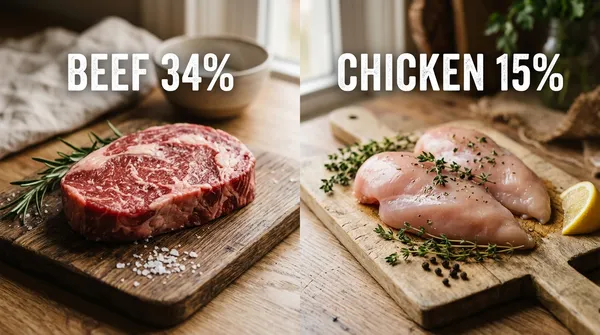
Dropping Chicken May Do Nothing for Your Dog — The Real Allergy Data
Where egg actually sits among canine trigger proteins, and why the rankings are a starting hypothesis rather than an answer.
Read Article →
The Dog Elimination Diet: How to Actually Track It
The full protocol — and the logging that makes a slow, cumulative effect visible instead of invisible.
Read Article →