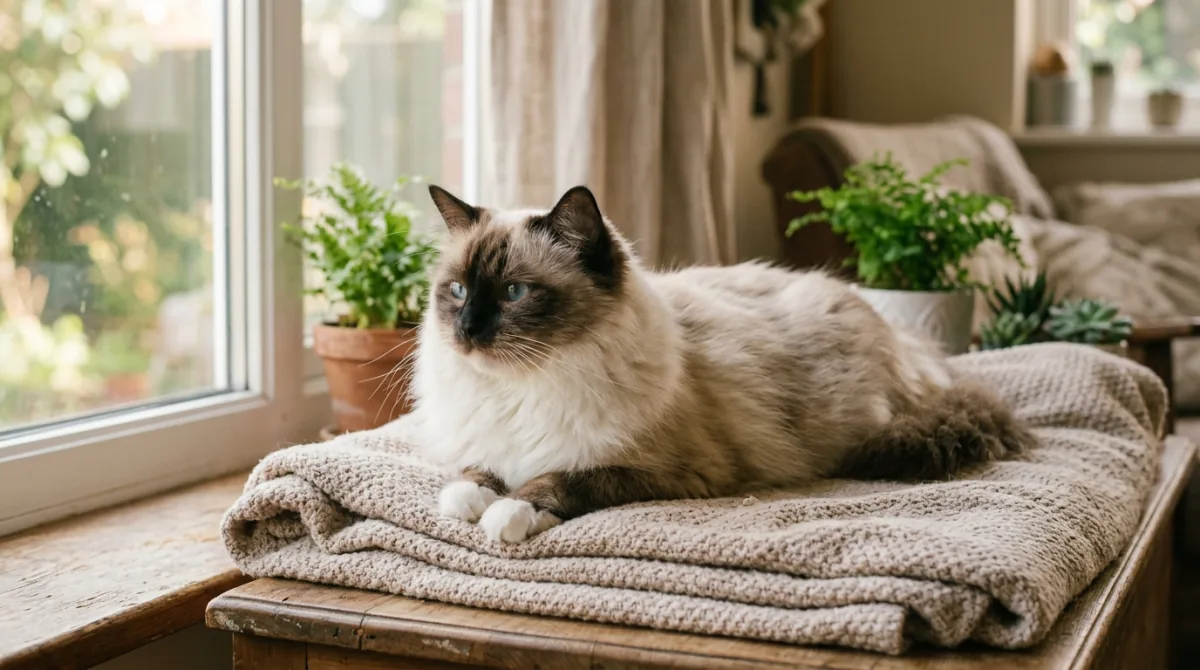
You didn't notice the over-grooming. You noticed the fur came out in clumps. By the time the bald patch on her belly was visible, she'd been telling you something for weeks under that long coat.
Ragdolls are stoic — they tolerate things other cats would tell you about. The breed is famously docile. And the long coat hides the early symptom signals owners of short-haired cats catch in week one. None of that means your Ragdoll is more allergic than other cats. It means the diagnostic instrument — your daily observation — has to work harder.
This is the breed-specific guide. The general cat-allergy framework is in the full cat food allergy prevalence breakdown; this article covers what's different about a Ragdoll.
Are Ragdoll cats hypoallergenic? (the myth that costs you the symptom)
No. Ragdolls are not hypoallergenic. No cat truly is.
The hypoallergenic-cat myth confuses two unrelated things:
- The allergen people react to in cats is Fel d 1, a protein produced in feline saliva and sebaceous glands and spread through grooming. Every cat produces Fel d 1 regardless of coat length, colour, or breed. Long coats, short coats, hairless — Fel d 1 is universal (Bonnet-Garin et al. 2020; NIH NIAID feline allergen literature).
- Food reactions in cats are responses to ingested proteins (beef, fish, chicken, dairy) — not coat-mediated, and not related to whether humans react to your cat. And most of what owners call a "food allergy" is really a delayed food sensitivity: a slow adverse food reaction over days, not the immediate, IgE-driven reaction the word technically means — which is why an elimination trial, not an allergy test, is what finds it.
The two questions get blurred in marketing copy: "hypoallergenic Ragdolls" and "Ragdolls don't get allergies" are different claims, and both are wrong. The better question for an owner is: what's driving my Ragdoll's symptoms — and how do I find out? The rest of this article answers that.
Ragdoll-specific risk profile
There is no peer-reviewed Ragdoll-specific food-allergy prevalence study. General cat-allergen/trigger prevalence applies to Ragdolls — any source citing breed-specific percentages is extrapolating without data. What we do have:
- Breed temperament — Ragdolls are widely described as docile and stoic (TICA, CFA breed standards). Discomfort signals may be subtler and later than in more vocal breeds.
- Coat length and density — semi-long, plush coat. Over-grooming and skin lesions are physically harder to see under it.
- Body size — Ragdolls average 12-20 lbs (TICA / CFA), males at the upper end. Matters for elimination-diet portioning — covered below.
These are breed characteristics that change the diagnostic experience, not breed-specific allergy rates.
Why long-hair makes food-reaction signs harder to spot
Three concrete patterns:
- Over-grooming is the act; matted fur is the result. In a short-haired cat, you see the grooming. In a Ragdoll, you see the consequence — patches of thinned coat, mats where the cat licks repeatedly, fur clumps in the brush. The behaviour ran for weeks before the evidence became visible.
- Skin lesions hide under coat. Miliary dermatitis — the small crusty bumps that signal feline food reaction — is felt before seen. On a Ragdoll, part the fur and run your hand along the back, flanks, and base of the tail weekly.
- Coat quality changes precede visible symptoms. Dullness, loss of shine, increased shedding, texture changes. If the coat feels different, log it.
The chicken-beef-fish reality for Ragdolls
Common feline food triggers in the veterinary literature are beef, fish, and chicken — in roughly that order (Mueller et al. 2016). Those are general feline numbers, not Ragdoll-specific — the same pattern applies to your Ragdoll.
For the full prevalence breakdown across all the common proteins, see the full cat food allergy prevalence breakdown — it carries the numbers and the symptom-pattern detail. If you specifically suspect chicken, the cat chicken-allergy guide covers that path.
Calorie scaling for a 12-20 lb cat on elimination diet
Most cat elimination-diet portion calculations assume an 8-10 lb cat. For a 15-lb Ragdoll, that math is off. Under-feeding the elimination protein means under-running the trial — your cat grazes, eats a treat someone "just gave her once," and the elimination fails.
General scaling principles (not prescription — consult your vet for individual cats):
- Resting energy requirement scales with body weight to roughly the ¾ power, not linearly. A 15-lb cat needs more food than a 10-lb cat, but not 50% more.
- Calculate daily calories for the cat's current weight; provide that load entirely from the single novel-protein diet.
- Adjust over 2-3 weeks based on weight trend. Slow weight loss is fine; rapid loss means under-feeding.
- Multi-cat households: cross-contamination from another cat's bowl undermines the trial. Separated feeding for 8-12 weeks is non-negotiable.
Reading Ragdoll-specific symptom patterns
What to watch for, with the Ragdoll-specific framing:
- Post-meal vomiting in the 2-24 hour window. Easy to dismiss as hairballs in a long-haired cat. Track the timing — hairballs are not consistently tied to meals; food reactions are.
- Hair loss on the belly and inner thighs. These are the places the long coat parts naturally during grooming — patches show here first, often before anywhere else.
- Coat-quality changes. Dullness, loss of plushness, increased mats. Subtle, but informative.
- Behavioural quiet. A normally docile Ragdoll becoming more withdrawn or hiding more can be the pain signal a more vocal breed would deliver directly. Track changes from the baseline you know.
The elimination diet protocol for Ragdolls (brief — full methodology in the cat elimination-diet guide)
The full 8-12 week elimination protocol — protein selection, transition timing, what to do when symptoms partially resolve, the reintroduction step — lives in the 8-12 week elimination protocol. Ragdoll-specific adjustments to layer on:
- Texture matters. Some Ragdolls are texture-fussy. Plan for 2-3 protein options if the first novel protein gets refused.
- Grooming products review. The long coat means more grooming-product exposure. Audit shampoos, conditioners, and wipes during the trial.
- Multi-cat exposure paths. If you have other cats, the trial requires separated feeding. Shared water bowls are fine; shared food bowls undermine the trial.
When breed-specific advice meets individual cat reality
Your Ragdoll is a cat. The general cat-allergy framework applies. The breed adjustments worth making are about detection and protocol logistics — the long coat, the temperament, the body size, the multi-cat household dynamic. None of those change what's actually happening biologically.
The detection work is what the tracking is for. Document symptoms, food, and timing through the trial. The pattern emerges from the data — under the fur, the data is still there.
Track your Ragdoll's diet and symptoms through the elimination protocol.
Frequently Asked Questions
Are Ragdoll cats hypoallergenic?
No. Fel d 1, the protein most people are allergic to in cats, is produced by every cat regardless of coat type or breed. Ragdolls produce it like any other cat. Separately, the hypoallergenic myth gets confused with "Ragdolls don't get allergies" — also not true. Ragdolls get food sensitivities and environmental allergies like any other cat; no breed-specific prevalence evidence exists either way.
Why is my Ragdoll over-grooming?
Over-grooming in cats is most commonly a stress, pain, or itch signal. Food sensitivity is one possible itch driver; environmental atopy (pollen, dust mites), parasites, and skin infections are others. The pattern matters: focal over-grooming on belly and inner thighs leans food-related; whole-body itching leans environmental. Track location, timing, and meal correlation.
How much novel protein for a 15 lb Ragdoll on elimination diet?
There's no one-size formula. Daily calorie need scales roughly with body weight to the ¾ power — a 15-lb cat needs more than a 10-lb cat, but not 50% more. Your vet can calculate a specific daily calorie target; provide that load entirely from the elimination protein. Adjust over 2-3 weeks based on weight trend.
Are Ragdolls more prone to food allergies than other cats?
There is no peer-reviewed Ragdoll-specific food-allergy prevalence study. General feline food-allergen prevalence applies — common allergens are beef, fish, and chicken (Mueller 2016). What's different about Ragdolls is detection difficulty (long coat, stoic temperament), not allergy rate itself.
What's the most common food allergen in cats?
Beef ranks highest in the veterinary literature, followed by fish, then chicken (Mueller et al. 2016). For the general feline allergy symptom guide, the cross-protein breakdown lives there.
How long should a Ragdoll's elimination diet take?
Eight to twelve weeks on a single novel protein fed exclusively, followed by a reintroduction step to confirm. Ragdolls don't require a different timeline than other cats — but the texture-fussiness and the multi-cat household logistics may push you toward the longer end of that window. The full protocol is in the 8-12 week elimination protocol.
References
- Mueller RS, Olivry T, Prélaud P. 2016. "Critically appraised topic on adverse food reactions of companion animals (2): common food allergen sources in dogs and cats." BMC Vet Res, 12:9. PMID: 26754631.
- Verlinden A et al. 2006. "Food allergy in dogs and cats: a review." Critical Reviews in Food Science and Nutrition, 46(3):259-273.
- Bonnet-Garin JM et al. 2020. Feline allergen Fel d 1 — production and modulation literature, J Feline Med Surg and related reviews.
- "Food Allergy in the Cat: Diagnosis by Elimination." 2024. PMC11220937.
- Cornell Feline Health Center. "Feline Food Allergies — Diagnosis and Management."
- VCA Animal Hospitals. "Food Allergies in Cats — Elimination Trial Protocol."
- The International Cat Association (TICA) — Ragdoll breed standard.
- The Cat Fanciers' Association (CFA) — Ragdoll breed standard.
Veterinary disclaimer: This article is for educational purposes only and does not constitute veterinary advice. Always consult with a qualified veterinarian before changing your pet's diet or discontinuing any prescribed treatments. Persistent itching, ear infections, and skin irritation can have multiple causes — including environmental allergens, parasites, bacterial or yeast infections, and structural conditions — some of which require specific veterinary treatment. Breed-specific sensitivities vary by individual cat; genetics, environment, and secondary conditions all shape what your pet reacts to. Persistent or severe symptoms should always be evaluated by a veterinary professional. This article does not replace a professional veterinary examination. If you observe signs of anaphylaxis, severe vomiting, collapse, or rapid deterioration, seek emergency veterinary care immediately.
Related Articles

Cat Food Allergy Symptoms: What You're Probably Missing
Cats with food sensitivities show different signs than dogs — and the #1 cat allergen is one most owners would never guess. Learn what to look for and how to track it.
Read Article →
Cat Elimination Diet Guide: 8–12 Week Protocol
Cat elimination diets take 8–12 weeks — longer than most owners expect. The complete step-by-step protocol, every failure point, and how tracking turns 84+ days into usable data.
Read Article →
Is My Cat Allergic to Chicken? Symptom Pattern Guide
Chicken is only ~5% of cat food allergens — but if your cat is in that 5%, the symptom pattern is recognisable. Here's how to spot it and confirm it.
Read Article →