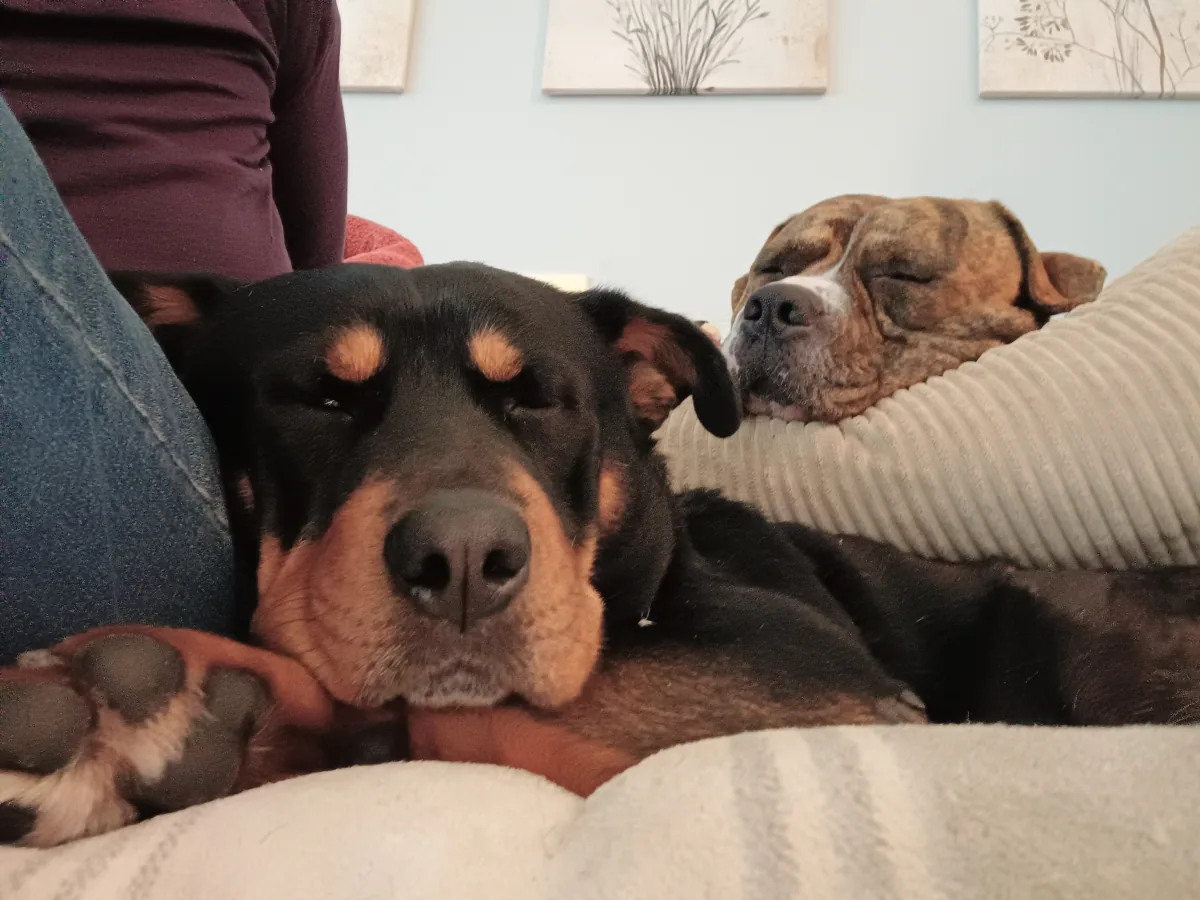
Some mornings I just stand in the kitchen and watch him eat.
That probably sounds strange. But if you're reading this — if your dog has cancer, or survived it, or is somewhere in between — you might understand. There's a weight to watching your dog eat a meal when you spent months not knowing if you were feeding him the right thing. Or the wrong thing. Or if it even mattered.
Shadow eats kangaroo and fish now, with a little duck in the rotation. Every single day, it's some combination of those three. He's bright-eyed, his coat is full, and he moves through the house the way a dog should — like the world is still interesting and he's got places to be. He didn't always look like this. And there was a long stretch where I didn't know if he ever would again.
This is our personal experience with Shadow. Every dog's cancer journey is different. Always work with your vet.
Before the Diagnosis
Shadow came to me as an emergency foster, about three weeks after my old pitbull Dude had to be put to sleep from cancer. Shadow had been living in a car with a homeless person — and when his keeper needed to go to hospital, no one wanted to take in an intact rottweiler. Friends of mine persuaded me to foster him for a couple of days. He went back and forth a few times after that, until the weather started getting hot and the car wasn't safe for him anymore. Then he came to stay with me for good — still technically as a foster. His skin was a mess. Chronic yeast infections, constant irritation, dull coat, constant scratching, biting his flank and licking his paws.
I put him on raw immediately. But even on raw, the problems continued. Good days followed by off days with no obvious explanation. A dip in energy here. A change in digestion there. Nothing dramatic. Nothing that screamed this is the problem. Just a quiet pattern I couldn't see because I wasn't tracking it yet.
Shadow was the first dog I ever started logging for. Dude — my old pitbull — had thrived on raw for years after I rescued him, and that experience had already taught me that what goes into a dog matters more than almost anything else. So with Shadow, once it was clear that raw alone wasn't enough, I did the only thing I could think of. I started writing it all down. Every meal. Every reaction. Everything I noticed afterwards.
DJ arrived about six weeks after Shadow, an 11-week-old puppy. He seemed fine. He was fine, until he was fifteen months old — when his first pancreatitis attack nearly killed him before we'd caught his triggers. A few more flare-ups through that year made it obvious I'd outgrown a notebook. That's when I started building what became the tool I use now. DJ's situation reinforced what Shadow had already taught me — that food sensitivity reactions can be delayed by days, which is why elimination diets done by memory alone so often fail.
I didn't know what I was looking for. I just knew I was done guessing.
It took weeks of consistent, daily logging before the picture started to emerge. Shadow is sensitive to most proteins. Only a handful are safe for him. Beef dragged him down. Lamb did the same. Fish & kangaroo brought him back to himself. Once I had that data, his skin cleared, his energy stabilised, and I finally understood what his body needed.
That foundation would turn out to be the most important thing I'd ever built for him.
The Injury That Changed Everything
The cancer didn't announce itself.
Shadow injured his hind leg. Nothing dramatic — the kind of thing an active dog runs into. Our vet suggested paracetamol for the pain, and I gave it to him for three days.
Within seven to ten days of that first dose, a small bump appeared on his third eye lid. Even our vet thought it was a cherry eye — the prolapsed third-eyelid gland that's common enough in certain breeds. Over the next two and a half weeks it grew. Faster than a cherry eye should. But we were already scheduled for surgery to correct it, so we went in.
It was only once they had him on the operating table that they realised what they were actually looking at. Not a cherry eye but a tumour. And the pathology report confirmed the worst — a rare cancer with an unknown expected outcome.
Would the paracetamol have nudged an already-growing tumour? I've come to suspect it might have. What I've learned since is that some pain medications can lean on an immune system that's already overwhelmed — and Shadow's was. I'm not making a medical claim. I'm telling you what a dog owner has to sit with after the fact. Everything going into your dog counts. Not just food. Medications. Supplements. Topicals. The chemicals on the grass they run on. The cleaning products on the floor they sleep on. All of it draws on the same capacity you're already watching when you track food. Ask the questions. Watch the timing. And track the quiet days too. Those are the ones with the answers.
The Diagnosis No One Prepares You For
The vet said the words "dirty margins".
Here's what it means, in plain language: when they removed Shadow's tumour, the pathologist looked at the edges of the tissue. If those edges are clean — no cancer cells — that's good news. It means they got it all. But Shadow's margins weren't clean. They were "dirty." Cancer cells were still present at the edges of what they took out.
Which means some were probably left behind.
You leave the vet's office with a dog who just survived surgery and a sentence lodged in your chest: we didn't get it all. And then you go home. And you stand in your kitchen. And you have to decide what to put in his bowl.
That's the part nobody tells you about. The diagnosis has a protocol. The surgery has a plan. But the next morning — when your dog looks up at you, hungry, trusting — that part is on you.
If you're here because your dog has cancer, I want you to know: that feeling of standing in the kitchen, paralysed by a question as simple as what do I feed him now — you are not alone in that. Not even close. Research shows that more than half of dog owners change their pet's diet after a cancer diagnosis. The instinct to do something, to control the one thing you can still control, is universal. It's not irrational. It's love.
But here's what made Shadow's situation different: I'd already been tracking his food for months before the cancer diagnosis. I didn't have every answer — I was still fine-tuning — but I had a good working picture of what was helping him and what wasn't. I didn't have to start from zero. I didn't have to guess blindly. That foundation — built through patient daily logging when the stakes felt lower — let me feed him through treatment with more confidence than I'd have had otherwise.
When Every Meal Feels Like a Gamble
Not everyone has that head start. Most people standing in their kitchen after a cancer diagnosis do what I did when Shadow first arrived: go online.
Within an hour you'll have seventeen tabs open. High protein. Low carb. Omega-3 fatty acids. Avoid grains. Try raw. Don't try raw. Cook everything. Don't cook anything. One site says beef is excellent for dogs with cancer. Another says to avoid red meat entirely. Every article has a different answer, and all of them sound confident.
The dog cancer diet advice online is overwhelming — not because there isn't enough information, but because there's too much. And almost none of it accounts for the fact that your dog is not every dog. Shadow is not a generic "canine cancer patient." He's a specific animal with a specific body and specific responses to specific foods. The general guidance about macronutrient ratios and supplement protocols — it's not wrong, exactly. It's just not enough. Not when the margins are dirty and every choice feels like it carries weight it shouldn't have to.
The other thing nobody tells you: your dog with cancer might also have food sensitivities. Those two things aren't separate problems. Shadow's cancer recovery went as smoothly as it did because we'd already identified his sensitivities through tracking. Without that data, his post-surgery recovery would have been a guessing game on top of an already terrifying situation.
What Tracking Through Cancer Looked Like
By the time the cancer diagnosis arrived, I already had months of data. I knew beef and lamb consistently dragged Shadow down — a heaviness, a slowness to get up, subtle changes in digestion that were easy to dismiss as a bad day, the scratching and licking that would start days later and sometimes require multi-day exposure. And I knew fish & kangaroo brought him back to himself. Alert. Interested. Moving well. Digestion steady.
That knowledge didn't just help me feed him during treatment. It gave me something to bring to our vet — not "I think he's been a little off" but actual data showing how specific foods affected his energy, digestion, and recovery. That changes the conversation.
But I kept tracking through cancer recovery, because cancer survivorship changes things. His body was under new stress. His immune system was compromised. I needed to know if his responses were shifting — and they did, subtly, in ways I would have missed without the daily log.
That's the thing about food responses in dogs — especially dogs with complex health situations. The reactions are often delayed. They're often subtle. And they overlap with everything else that's going on, so your brain does what brains do: it looks for simple answers and misses the real ones. Tracking stripped away the noise. It showed me what was actually happening, not what I assumed was happening.
I cannot overstate what it felt like to walk into cancer treatment already having a working picture of what Shadow could and couldn't eat — even while I was still refining it. While other pet parents were standing in their kitchens paralysed by uncertainty, I had data I could act on. Not a shot in the dark. A pattern I could see and keep testing.
If you're navigating your dog's cancer journey and want to understand how food affects them day to day — that's exactly what tracking is for.
Shadow's patterns became clear after weeks of consistent tracking. If you want to understand how food affects your dog day to day — that's what this tool was built for.
Start Tracking Free — 14 Days, No Card NeededWhat Shadow's Diet Looks Like Now, 19 Months Post-Surgery
Shadow eats kangaroo and fish, with minimal duck and emu, plus his immune system and liver support supplements. That's the simple version.
The longer version: he eats a limited-protein rotation — mostly kangaroo and fish, with duck and emu kept deliberately small — that we arrived at through tracking, adjusted over time, and continue to monitor. It's not a miracle protocol. It's not something I found in a book. It's what works for Shadow — specifically, precisely, observably.
His mornings start with a meal of kangaroo or fish & either emu or a duck foot. He eats with enthusiasm, which might sound like a small thing, but if you've ever watched a sick dog turn away from food, you know it isn't small at all. His coat is healthy. His energy is steady — not manic, not sluggish, just the quiet aliveness of a dog who feels good in his body.
What matters most to me isn't just that I found what to avoid. It's that I confirmed what works. There's an enormous difference between I took beef away and hoped for the best and I can see, in weeks of data, that kangaroo and fish consistently support Shadow's wellbeing. The first is a guess. The second is something I can stand behind. Something I can bring to our vet and say: here's what I'm seeing. Here's the data. Here's what's working.
We still track. Cancer survivorship isn't a single event — it's ongoing. Shadow's needs could change. His responses could shift. Tracking means I'll see it if they do, not weeks later when I finally notice something's off, but in the data, as it happens. That ongoing attention is the part that gives me peace.
What I'd Tell Every Dog Cancer Parent
You can't control the cancer. I know that. You know that. It's the first thing you learn and the last thing you accept.
But you can control what goes in the bowl. And that turns out to make a real difference in their daily comfort — not because food treats cancer (it doesn't), but because what your dog eats affects how they feel every single day. Their energy. Their comfort. Their digestion. Their ability to enjoy the life they still have. When the big thing is out of your hands, the daily things become everything.
Here's what I wish someone had told me:
Track before crisis hits. The single best thing I did for Shadow was start tracking before the cancer diagnosis — when the stakes felt lower. By the time the terrifying news came, I already had data. If your dog has any unexplained symptoms — skin issues, digestive trouble, energy dips — start tracking now. Don't wait for a crisis to wish you'd started sooner.
Work with your vet. I say this without hesitation. Tracking doesn't replace your vet. What it does is give you something to bring to those appointments beyond "he seems okay" or "I think he's been a little off." Imagine walking in with six weeks of food-and-response data. That changes the conversation. Your vet can't act on information they don't have. Tracking fills that gap.
Don't expect instant answers. Shadow's patterns took weeks to become clear. That's hard when you're anxious and want answers now. But the delayed nature of food responses — sometimes two, three, even four or even more days after a meal — is exactly why tracking matters and why guesswork fails. Your brain can't hold a multi-day lag. A log can.
Every dog is different. Shadow can't tolerate beef or lamb. Your dog might thrive on both. That's the whole point. Generic dog cancer diet advice can point you in a general direction, but your dog's body is the only authority on what actually works for your dog. Tracking is how you hear what it's telling you.
And the last thing, the thing I wish someone had said to me in the vet's car park on the day we heard "dirty margins": You are not helpless. It feels that way. It doesn't have to stay that way. There are things you can do — practical, daily, concrete things — that support your dog's quality of life. Paying attention is one of them. Tracking is how you make that attention count.
You Don't Have to Figure This Out Alone
I built this app because I needed it. Not in a business-plan sense — in a standing-in-my-kitchen-at-midnight, trying-to-remember-what-Shadow & DJ ate-three-days-ago sense. I was managing Shadow's cancer recovery and DJ's pancreatitis triggers simultaneously, and the spreadsheets were failing me. I needed something that could track meals, symptoms, energy, and behaviour for multiple dogs — and then help me see the patterns I was missing.
That's what Carnivore Lifestyles does. One account covers every pet (and human) in your household. Logging takes under two minutes a day. And the pattern detection catches connections you can't — including delayed reactions that show up days after the food that caused them.
You don't need to be a data scientist. You don't need to be organised. You just need to show up for two minutes a day and let the data do what your memory can't.
If you're navigating a dog cancer diet for the first time, or managing a cancer survivor's long-term nutrition, or just trying to figure out why your dog seems off and you can't pinpoint what's causing it — this is the tool I wished existed when I needed it most.
I built it so you wouldn't have to build your own.
Stop guessing. Start tracking. Log meals and symptoms in under 2 minutes a day — the app spots the delayed patterns memory can't.
Start 14-Day Free TrialShadow Today
It's a Wednesday morning and Shadow is crunching on his kangaroo spine bone. He cleaned his bowl twenty minutes ago — kangaroo this morning — and now he's doing that thing dogs do. Content. Present. Unworried about margins or prognoses or what comes next.
He doesn't know any of it. He doesn't know about the months of tracking that came before the surgery, or the pathology report, or the nights I spent worrying about dirty margins. He doesn't know about the spreadsheets that became an app. He just knows that his bowl shows up every morning, that it holds the food his body gets along with, and that he feels good.
That's enough. That's everything, actually.
Shadow is still here. He's thriving. Not because we found a cure — because we paid attention. Because we tracked what mattered, saw what the data showed us, and gave him exactly what his body needed.
I can't promise you the same outcome. Every dog's cancer is different. Every body responds differently. But I can tell you this: knowing is better than guessing. Every single time.
And Shadow — is proof of that.
References
- Mueller RS, Olivry T, Prélaud P. 2016. "Critically appraised topic on adverse food reactions of companion animals (2): common food allergen sources in dogs and cats." BMC Vet Res, 12:9. PMID: 26754631.
- Ogilvie GK, Vail DM. "Nutrition and cancer: recent developments." Veterinary Clinics of North America: Small Animal Practice, 20(4):969–985.
- Withrow SJ, Vail DM, Page RL (eds). Withrow & MacEwen's Small Animal Clinical Oncology, 5th Edition. Saunders, 2013.
Shadow's story is one family's personal journey. Individual outcomes in veterinary oncology vary widely — cited sources are provided for readers who want to explore the broader literature on canine nutrition and cancer care.
Disclaimer: This article is for educational purposes only and does not constitute veterinary advice. Always consult with a qualified veterinarian before changing your pet's diet or discontinuing any prescribed treatments. The experience described in this article is one family's personal journey — every dog's cancer, treatment plan, and dietary needs are different. Persistent or severe symptoms should always be evaluated by a veterinary professional. This article does not replace a professional veterinary examination. If you observe signs of anaphylaxis, severe vomiting, collapse, or rapid deterioration, seek emergency veterinary care immediately.
Related Articles
DJ's Story: How Tracking Saved My Dog's Life (and Stopped the 2am ER Visits)
A companion personal story to Shadow's. DJ's first pancreatitis attack at fifteen months made it obvious that tracking was the only way to stay ahead of his triggers.
Read Article →
Your Dog's Elimination Diet Is Useless Without This One Step
The elimination diet protocol is straightforward. The reason most attempts fail isn't the diet — it's the missing tracking layer that catches delayed responses.
Read Article →
Food Sensitivities in Pets: Uncovering the Hidden Culprits Behind Common Symptoms
Food sensitivities are delayed, cumulative, and easy to miss. Here's how they actually present — and why systematic tracking is the only way to catch the pattern.
Read Article →