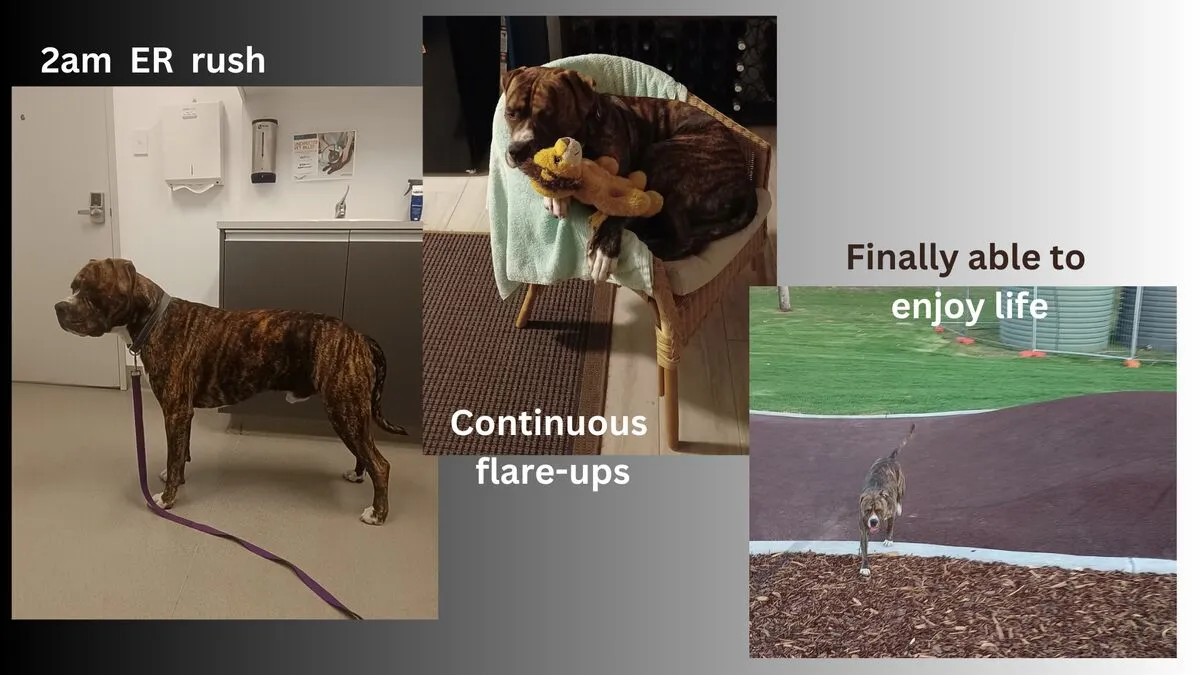
This article is written by Kristina, founder of Carnivore Lifestyles and ItchyPet — and DJ's person.
The first time DJ ended up in the emergency vet at 2am, I thought it was a one-off. Something he'd got into. Bad luck.
The second time, I started to panic. The third time, I was running on no sleep and completely without answers. He was on the same food. Nothing had changed. The vets were doing everything right — stabilising him, managing the pancreatitis, sending us home with dietary advice. But nobody could tell me why it kept happening. Or what the pattern was. Or what, precisely, I needed to remove from his life to make it stop.
What I know now — pieced together through months of tracking, veterinary investigation, and a lot of research — is that DJ's pancreatitis episodes were not being triggered by fat alone, or by a single dietary offender. There was a pathway involved. A cascade that started in his gut, ran through his colon, and escalated to his pancreas. And stress was the accelerant that turned a manageable inflammatory load into a crisis.
Understanding that pathway changed everything.
The Hidden Connection Between the Gut and the Pancreas
Most people — and many general practice vets — think of pancreatitis as a standalone event. The dog ate something too fatty, or got into the bin, or was fed a piece of Christmas ham. And yes, that can absolutely be a trigger. But in dogs like DJ, where episodes are recurring and unpredictable, the mechanism is often more complex than a single dietary event.
Here's the connection that changed my understanding:
The pancreatic duct and the bile duct share a common opening into the duodenum (the first part of the small intestine). This means that inflammation in the gut — particularly in the upper GI tract — can directly affect the pancreas. When the intestinal lining is inflamed, it can obstruct or irritate the pancreatic duct, causing digestive enzymes to back up into the pancreas itself. That's when things go wrong.
In veterinary medicine, this is known as the IBD-pancreatitis overlap, and it's well-documented. Studies have shown that dogs with inflammatory bowel disease (IBD) have significantly higher rates of concurrent pancreatitis. In one study, elevated pancreatic lipase immunoreactivity (a marker of pancreatic inflammation) was found in a notable proportion of dogs diagnosed with IBD — even when they had no obvious clinical signs of pancreatitis at the time.
In other words: chronic gut inflammation can silently prime the pancreas for an acute episode. The dog doesn't look like a pancreatitis case — until suddenly they are one.
And the gut inflammation doesn't have to be dramatic. It can be low-grade. Ongoing. Caused by something as subtle as a food sensitivity that no one has identified — because the symptoms were written off as "just a sensitive stomach" or "he always has soft stools."
The Trigger Nobody Mentioned: Physical Stress and Heat
DJ is a large mastiff-type dog — heavy muscle mass, powerful build. The vets talked about dietary fat as a trigger. They never once mentioned physical stress.
But when I started tracking, a pattern emerged that had nothing to do with boarding, fireworks, or routine changes. DJ's colitis flares consistently followed exercise on warm days. Not extreme heat — we're talking 23°C, even in the shade. Just enough warmth that a large, heavily muscled dog playing with his housemate would generate more heat than his body could efficiently shed. This experience — tracking for DJ, Shadow, and myself — is what ultimately led me to build this platform. Read more in my founder story.
What I didn't understand at the time was that exercise-induced colitis is not a separate condition from the pancreatitis pathway — it's part of it.
Here's the mechanism that the research supports but that rarely gets discussed in general practice: during physical exertion, the body diverts blood away from the gut to the muscles and skin (for cooling). This is called splanchnic vasoconstriction, and it causes intestinal ischemia — reduced blood flow to the gut lining. In a dog who is also heat-stressed, the damage is compounded: intestinal tissue hyperthermia, excessive reactive oxygen species production, and direct breakdown of the gut barrier.
Research on athletic dogs has documented that sustained exercise produces a significant increase in intestinal permeability — the gut literally becomes more "leaky." In a healthy dog with an intact gut, this may cause no visible symptoms. But in a dog whose GI tract is already compromised — by food sensitivities, by chronic low-grade IBD, by a gut barrier that's never quite intact — the physical stress becomes the tipping point. The colon flares. Mucousy, bloody diarrhoea follows. And in DJ's case, that colitis was the first step in a cascade that ended at the pancreas.
Large breed and heavy-muscled dogs are at particular risk. Dogs over 15kg are documented as being more vulnerable to heat-related GI stress. A mastiff-type dog doesn't need to be running in 35°C heat — moderate activity on a mildly warm day can be enough, because the heat generated by large muscle mass during exercise has nowhere to go fast enough.
The pattern in DJ looked like this:
- Baseline gut inflammation from an unidentified food sensitivity (low-grade, chronic, easy to miss)
- Physical stress — exercise on a warm day — triggers gut barrier breakdown and acute colitis (diarrhoea, mucus, blood)
- Colonic inflammation amplifies intestinal inflammation already present in the upper GI tract
- Duodenal inflammation affects the pancreatic duct
- Pancreatic enzymes activate prematurely — acute pancreatitis
This cascade didn't happen every time he exercised. It happened when physical stress landed on top of an already-inflamed gut. The food sensitivity was the kindling. The exercise and heat were the match.
What DJ's Pattern Actually Looked Like
Before I started tracking, the ER visits seemed random. Some weeks he was fine; others, he'd crash. No one could tell me why.
I started logging everything — meals, treats, exercise, weather, stool quality, energy, behaviour — and after a few months I started suspecting physical stress as a trigger. The pattern became clear.
The sequence was almost always the same:
- Baseline: DJ's gut was chronically inflamed from two food sensitivities I hadn't yet identified — a fish allergy, and a sensitivity to excess organ-related nutrients. His raw food supplier had been mixing organs and heart meat into his meals without declaring them as separate ingredients on the label. So he was getting far more organ content than I realised, and I had no way of tracking it accurately.
- The trigger event: Exercise on a day above 23°C — even a walk in the shade, or a play session with his housemate on a mild afternoon.
- 36–48 hours later: Colitis flare. Mucousy stools, urgency, blood, refusing food.
- When food sensitivities were still active: The colitis would escalate. The gut inflammation — already primed by the fish and organ overload — would cascade upward through the GI tract to the pancreas. Vomiting, abdominal pain, the "prayer position," profound lethargy. ER visit.
Without the tracking log, I couldn't see this. The ER visits seemed to come out of nowhere. But looking at the data, the pattern was remarkably consistent. Every pancreatitis episode was preceded by a colitis flare. Every colitis flare followed exercise in warm weather. And the severity of the cascade depended on how inflamed his gut already was from the food sensitivities I hadn't yet removed.
Once I identified and removed the fish and reduced the organ content, the exercise-induced colitis stopped escalating to pancreatitis. I'm still fine-tuning the exact temperature and walk-length threshold that DJ can tolerate without triggering a colitis flare — but the pancreatitis cycle is broken.
What Pancreatitis Is — And Why It Escalates the Way It Does
Pancreatitis is inflammation of the pancreas — but that simple definition doesn't capture how dangerous it can be.
The pancreas produces powerful digestive enzymes that are meant to activate only once they reach the small intestine. In pancreatitis, those enzymes activate prematurely — inside the pancreas itself. The organ essentially begins digesting itself.
Acute pancreatitis can range from mild (loss of appetite, nausea, mild abdominal pain) to severe and life-threatening (organ failure, sepsis, DIC — disseminated intravascular coagulation). In severe cases, the fatality rate is significant.
Chronic pancreatitis involves ongoing, low-grade inflammation that can smoulder for months or years, punctuated by acute flare-ups. Dogs with chronic pancreatitis often have vague, intermittent symptoms — occasional vomiting, reduced appetite, soft stools — that don't scream "emergency" until an acute episode hits.
The clinical signs of pancreatitis in dogs include:
- Repeated vomiting
- Abdominal pain (hunched posture, the "prayer position" where front legs are down and rear is elevated, reluctance to move)
- Loss of appetite — often complete food refusal
- Diarrhoea (sometimes bloody)
- Profound lethargy and weakness
- Fever
- Dehydration
- In severe cases: collapse, shock, organ failure
Diagnosis typically involves a combination of clinical signs, blood work (the SNAP cPL or Spec cPL test for canine pancreatic lipase), and abdominal ultrasound. However, mild or chronic pancreatitis can be difficult to diagnose definitively — blood markers may be borderline, and ultrasound findings can be subtle.
Treatment for acute episodes is primarily supportive: IV fluids, anti-nausea medication, pain management, and careful reintroduction of food. There is no "cure" for pancreatitis — management is about preventing recurrence, which is where understanding the trigger pathway becomes critical.
Dogs at Higher Risk for the IBD-Pancreatitis Cascade
Not every dog with a sensitive stomach will develop this pattern. But certain factors increase the risk:
- Breeds predisposed to pancreatitis: Miniature Schnauzers, Yorkshire Terriers, Cocker Spaniels, Cavalier King Charles Spaniels, Collies, Boxers, and other breeds with known pancreatic or GI vulnerability
- Dogs with diagnosed or suspected IBD: Chronic vomiting, chronic diarrhoea, weight loss despite adequate feeding, or histopathological evidence of intestinal inflammation
- Dogs with recurrent colitis: Especially colitis triggered by physical stress or exertion that occurs alongside dietary sensitivity
- Dogs on chronic medications that affect the gut: Long-term NSAID use, repeated courses of antibiotics (especially metronidazole), or chronic steroid use
- Dogs with a history of multiple pancreatitis episodes: Each episode can cause scarring and make the pancreas more vulnerable to the next one
- Dogs with unidentified food sensitivities: Chronic low-grade gut inflammation that's never been properly investigated through an elimination diet
If your dog fits more than one of these categories, and they've had even one unexplained pancreatitis episode, the gut-pancreas connection is worth investigating.
What to Track If Your Dog Has This Pattern
Standard food tracking is a good start, but for dogs with the colitis-pancreatitis pattern, you need to go further. Here's what I wish I'd been tracking from day one:
- Every protein source — not just the main food, but every treat, chew, supplement, and flavoured medication. Read every ingredient list. Fish oil, undeclared organ meats, and hidden protein sources all count.
- Stool quality — in detail. Firmness (use a 1–7 scale), colour, mucus (yes/no/amount), blood (fresh red vs. dark), frequency, urgency. Changes in stool are often the earliest warning sign.
- Exercise and physical activity. Type (walk, play session, off-lead running), duration, intensity, and your dog's recovery. Note if they were panting heavily, slow to settle, or reluctant to move afterwards.
- Weather and temperature. Ambient temperature, humidity, whether exercise happened in sun or shade. For large or heavy-muscled breeds, even moderate warmth (23°C) during activity can be significant.
- Appetite and eating behaviour. Did they eat with enthusiasm? Hesitate? Leave food? Eat grass? Lip-lick or drool before meals? These subtle changes often precede a flare by days.
- Abdominal comfort signs. Stretching frequently, reluctance to jump up, the prayer position, guarding when touched on the belly, restlessness at night.
- Vomiting — with detail. Time of day, relation to meals (empty stomach vs. after eating), content (bile, foam, food, blood), frequency.
- Energy levels and behaviour. Withdrawal, reluctance to walk, sleeping more than usual, changes in interaction with people or other animals.
- Timeline of symptom progression. When tracking reveals a pattern, you can start to see the cascade unfold in real time — and intervene before it reaches the pancreas.
What Changed
Once I could see DJ's pattern clearly in the data, everything shifted.
The vets completely ignored the possibility of a connection between exercise and his flare-ups. But the tracking data didn't lie. I could see it clearly — and I acted on it myself.
DJ was already on a raw diet, but I went back to basics and restarted with a strict elimination diet. I changed how he exercised — shorter sessions, earlier in the morning before the heat built up, with cool-down periods and access to shade and water. On warmer days, we skipped the rough play entirely.
And I kept tracking. Every day. Because the data was what made the invisible visible.
DJ hasn't had a pancreatitis episode since May 2025. His stools are consistently formed. His energy is back. He's a different dog — not because I found a magic cure, but because I finally understood the pathway and stopped feeding the fire at its source.
The tracking didn't just help me understand what was happening. It gave me the evidence I needed to act with precision instead of guessing — even when the vets couldn't see it.
If your dog is caught in a cycle of recurring pancreatitis and nobody can tell you why, I'd encourage you to start tracking everything. Not because it will replace veterinary care — it absolutely won't. But because it will give you and your vet the one thing that's been missing: the pattern.
Data Sources
- Watson P. Pancreatitis in dogs and cats: definitions and pathophysiology. J Small Anim Pract. 2015;56(1):3–12.
- Xenoulis PG, Steiner JM. Canine and feline pancreatic lipase immunoreactivity. Vet Clin North Am Small Anim Pract. 2012;42(1):63–72.
- Mansfield CS, Jones BR. Plasma and urinary trypsinogen activation peptide in healthy dogs. Aust Vet J. 2000;78(6):416–422.
- Xenoulis PG. Diagnosis of pancreatitis in dogs and cats. J Small Anim Pract. 2015;56(1):13–26.
- Jergens AE, et al. Elevated serum pancreatic lipase immunoreactivity in dogs with inflammatory bowel disease. J Vet Intern Med. 2014;28(3):951.
- Mazzaferro EM, et al. Intermittent pancreatitis in a 2-year-old Chihuahua mixed breed dog. Can Vet J. 2006;47(2):147–150.
- SASH Vets. Inflammatory Bowel Disease and Pancreatitis.
- VCA Animal Hospitals. Colitis in Dogs.
- Zoetis Petcare. What is Stress Colitis in Dogs.
- Davis MS, et al. Effect of training and racing on intestinal permeability in sled dogs. Comp Exerc Physiol. 2005;2(3):161–166.
- Lambert GP. Stress-induced gastrointestinal barrier dysfunction and its inflammatory effects. J Anim Sci. 2009;87(14 Suppl):E101–108.
- Bruchim Y, et al. Heat stroke in dogs: a retrospective study of 54 cases (1999–2004) and analysis of risk factors for death. J Vet Intern Med. 2006;20(1):38–46.
- Tham HL. Elimination Diet Trials. Today's Veterinary Practice. 2024.
- Olivry T, Mueller RS. Critically appraised topic on adverse food reactions. BMC Vet Res. 2016;12:9.
Disclaimer: This article is for educational purposes only and does not constitute veterinary advice. Pancreatitis is a serious, potentially life-threatening medical condition requiring prompt veterinary diagnosis and treatment. If your dog shows signs of pancreatitis — repeated vomiting, abdominal pain, the "prayer position," profound lethargy, or collapse — seek emergency veterinary care immediately. Do not attempt to manage an acute pancreatitis episode with dietary changes alone. This article reflects the personal experience of the founder and is shared for informational and educational purposes only.