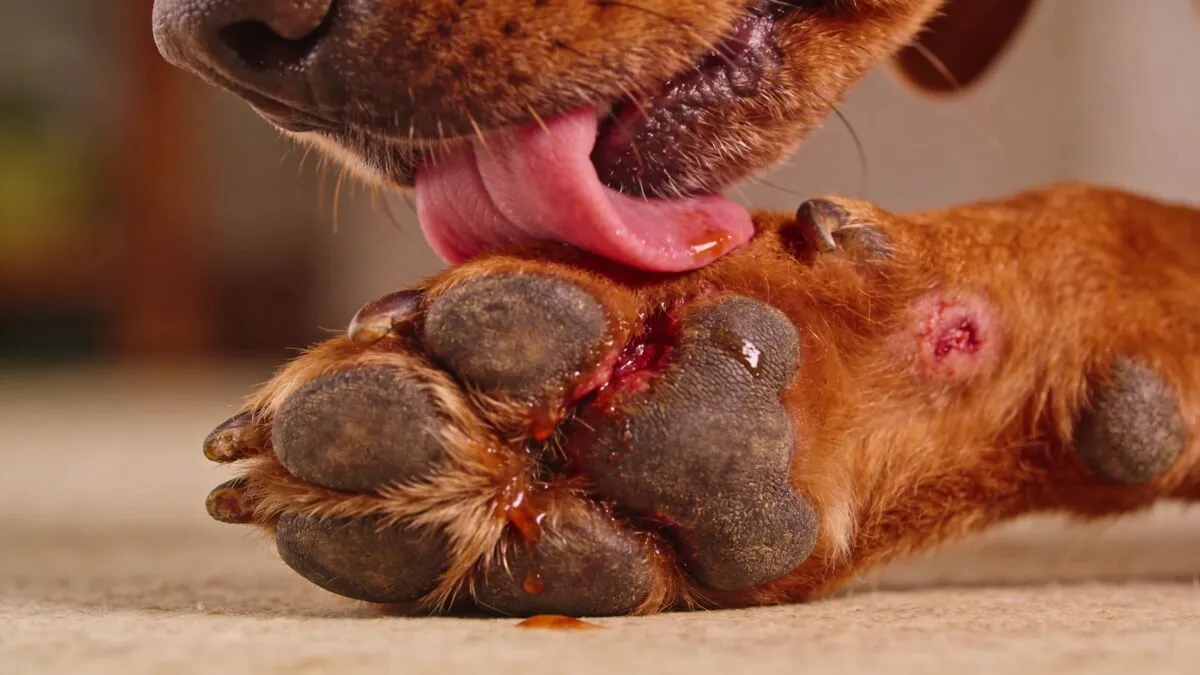
It happens every evening. Your dog settles down after dinner, and within minutes you hear it — the rhythmic, wet sound of paw licking. You call them off, they stop for a minute, then start again. Their paws are red between the toes. There's rust-coloured staining in the fur from weeks, maybe months, of this. You've tried washing their paws after walks. You've tried paw balm. You've been back to the vet twice.
The licking continues.
Here's what you may not have been told yet: persistent, compulsive paw licking is one of the most consistent outward signs of food sensitivity in dogs. It's not a grooming quirk. It's not boredom. And it's not the grass — at least, not for most dogs who lick this consistently and intensely.
It's your dog's skin telling you something is inflamed from the inside. The source is usually dietary, and the licking is the symptom, not the cause.
Why Dogs Lick Their Paws When Something Is Wrong Internally
The paws are among the most densely innervated parts of a dog's body, and they concentrate a significant amount of immune activity. When systemic inflammation is present — from food sensitivity, atopy, or other immune dysregulation — it tends to manifest intensely in the extremities: the paws, ears, and skin folds around the groin and armpits.
When food proteins trigger an immune response in the gut, inflammatory cytokines circulate through the bloodstream and reach peripheral tissues. In sensitive dogs, the paws become intensely itchy — not from any external irritant, but from internal inflammatory signalling reaching the skin. The licking is an attempt to relieve that itch. The saliva introduces moisture, bacteria, and yeast to already-compromised skin, which drives a secondary infection cycle that makes the itching worse and the licking more compulsive.
This is why washing paws after walks helps a little — you're removing potential topical irritants — but never fully resolves it. The primary driver is systemic, not topical.
The "Ears and Rears" Pattern — and Why Paws Fit It
Veterinary dermatologists describe a classic presentation for food-sensitive dogs: the "ears and rears" pattern. Dogs with adverse food reactions tend to develop recurrent ear infections (otitis externa), itching and redness around the perianal area, and — critically — persistent paw licking and chewing.
Paws fit this pattern because they share a key feature with the ears and groin: they are warm, moist, and have thin skin with high immune cell density. These areas are where inflammation concentrates when the immune system is reacting to something ingested, rather than something contacted topically.
The "ears and rears" pattern is not universal — some food-sensitive dogs itch all over — but when a dog presents with recurrent ear infections plus chronic paw licking plus rear-end licking or scooting, food sensitivity should be at the top of the differential list. Studies have shown that non-seasonal otitis externa combined with concurrent paw and perianal pruritus is among the strongest clinical indicators of cutaneous adverse food reaction in dogs.
If your dog has this combination of symptoms, particularly if they are non-seasonal (present year-round rather than flaring only in spring or autumn), a dietary investigation is warranted before or alongside treatment with immunosuppressive medications.
The Role of Yeast — and Why the Paws Smell Like Corn Chips
If your dog's paws have a distinctive musty, corn-chip-like odour, that's not just "dog feet." That smell is Malassezia pachydermatis — a yeast that naturally lives on canine skin in small numbers but can overgrow dramatically when the skin barrier is disrupted by chronic inflammation.
Here's how the cycle works:
- Food proteins trigger an immune response in the gut. Inflammatory mediators circulate systemically.
- Inflammation reaches the skin of the paws, disrupting the skin barrier and altering the local microenvironment (pH, moisture, lipid composition).
- Malassezia yeast proliferates in the warm, moist, inflamed skin between the toes and on the paw pads.
- The yeast itself triggers additional immune activation, producing more itching and more inflammation.
- The dog licks to relieve the itch, introducing saliva that adds moisture and further disrupts the skin barrier.
- The cycle intensifies. More moisture, more yeast, more inflammation, more licking.
This is why antifungal treatments (medicated shampoos, wipes, or oral antifungals) provide temporary relief but the problem always comes back. You're treating the secondary yeast overgrowth without addressing the primary inflammatory driver — which, in many dogs, is the food.
The rust-coloured staining you see on the fur around your dog's paws (and often around the mouth and eyes too) is caused by porphyrin, a pigment in saliva and tears. It's a visible marker of chronic, repetitive licking — and it tells you the behaviour has been going on for weeks or months, not days.
The Delayed Reaction Window — Why You Haven't Connected It to Food
The single biggest reason food sensitivity goes undiagnosed in paw-licking dogs is the delay between ingestion and symptom expression.
Unlike a true IgE-mediated food allergy (which can cause rapid symptoms like facial swelling or hives within minutes to hours), food sensitivities in dogs are typically delayed hypersensitivity reactions. The immune response builds over days. A dog who eats a trigger protein on Monday may not show increased paw licking until Thursday, Friday, or even the following week.
This delay makes the connection between food and symptoms nearly invisible without tracking. Most owners who've tried switching foods have looked for an immediate cause-and-effect — "I changed the food and the licking stopped" — and when that doesn't happen within a few days, they conclude the food wasn't the issue. If you're experiencing delayed food reactions yourself, tracking your own elimination diet follows the same principles.
But the timeline doesn't work that way. Removing a trigger protein can take 4 to 12 weeks to produce visible improvement in skin symptoms. And reintroducing a trigger can take days to two weeks to produce a flare. Without a daily log connecting food intake to symptom severity over weeks, these patterns are impossible to see.
This is also why the common approach of "trying a new food for a couple of weeks" almost never yields clear answers. Two weeks is not long enough for skin inflammation to resolve, and without tracking, even genuine improvement can go unnoticed because it happens so gradually.
Other Causes of Paw Licking — and How to Tell Them Apart
Food sensitivity is not the only cause of paw licking. A thorough investigation should consider the following:
- Environmental allergies (atopic dermatitis): Pollen, dust mites, mould, and grass can all cause paw itching. The key difference is seasonality — if paw licking is worse in spring and autumn and milder in winter, environmental allergens are likely contributing. However, many dogs have both food and environmental sensitivities simultaneously, and the two can be difficult to separate without an elimination diet.
- Contact irritants: Salt or chemical de-icers on winter pavements, lawn treatments, cleaning products on floors, and certain grasses can cause localised paw irritation. This is typically acute (appears after a specific walk or exposure) rather than chronic, and it affects the undersides of the paws more than the interdigital spaces.
- Foreign bodies: Grass seeds (foxtails), splinters, or thorns lodged between toes cause sudden-onset, intense licking usually focused on one paw. If the licking started abruptly and is localised to a single foot, a physical examination of the paw is the first step.
- Pain or injury: A cut, cracked pad, torn nail, or joint pain (arthritis in the wrist or toes) can cause a dog to lick one specific paw. This is usually unilateral and identifiable on examination.
- Behavioural (anxiety or compulsive disorder): True compulsive licking does exist, but it is significantly over-attributed. Behavioural paw licking should only be diagnosed after all medical causes have been thoroughly investigated and ruled out. Many dogs labelled as "anxious lickers" are actually itchy dogs whose underlying food sensitivity or atopy has not been identified.
The pattern that points most strongly to food: bilateral paw licking (both front paws, or all four), chronic and non-seasonal, combined with ear infections or rear-end licking, and unresponsive to topical treatments or environmental changes. If this describes your dog, a dietary investigation should be a priority.
What a Proper Elimination Trial Looks Like for Paw Licking
The elimination diet trial remains the only validated diagnostic method for food sensitivity in dogs. Blood tests, saliva tests, and hair tests for food sensitivity have no scientific validation — multiple independent studies have shown they produce unreliable results.
For a paw-licking dog, here is what a properly conducted trial involves:
- Choose a single novel protein your dog has never eaten. Common options include kangaroo, venison, rabbit, or horse. The protein must be genuinely novel — if your dog has eaten a "limited ingredient" food containing venison before, venison is not novel for that dog. A true elimination diet should be single-ingredient: one protein source plus bones and a small amount of organs from the same species. Avoid ultra-processed commercial "elimination" diets — they contain multiple ingredients your dog could be reacting to beyond just the protein.
- Feed only that protein source for 8 to 12 weeks. No treats, no chews, no flavoured medications, no supplements with unlisted protein sources, no table scraps, no other pets' food. Every protein that enters your dog's mouth must be accounted for.
- Treat any active secondary infections concurrently. If your dog has a yeast or bacterial infection in the paws, treat it with appropriate medication while running the trial. This allows you to see whether the inflammation resolves once the infection is cleared and the dietary trigger is removed.
- Track daily. Record what your dog ate, paw licking frequency and intensity (a simple 0-10 scale), paw redness, odour, staining, ear condition, stool quality, and overall behaviour. Take weekly photos of the paws.
- Do not judge results before week 8. Gut symptoms may improve by week 4-6, but skin symptoms — including paw licking — often need the full 8-12 weeks to show meaningful change. Many owners abandon trials too early and miss the window where improvement becomes visible.
- If symptoms improve, confirm with a challenge. Reintroduce the suspected trigger protein (e.g., chicken or beef) and monitor for 1-2 weeks. If paw licking returns or intensifies, that is a positive confirmation of food sensitivity to that protein.
The challenge phase is essential. Improvement during elimination alone does not confirm food sensitivity — it could be coincidental improvement from seasonal allergen changes, infection treatment, or other factors. The return of symptoms on challenge is what confirms the diagnosis.
Tracking Turns Months of Guessing Into Weeks of Data
Most owners of paw-licking dogs have already tried multiple interventions by the time they consider a dietary cause. They've tried paw washes, antihistamines, medicated shampoos, paw balms, grain-free food, "sensitive skin" formulas, and various supplements. Each attempt lasted a few weeks, and none produced clear results.
The common thread in all of these attempts is the absence of data. Without a daily record of what was eaten and what symptoms looked like, there is no way to evaluate whether any intervention was working, partially working, or being undermined by a hidden variable.
Tracking changes this fundamentally. When you log meals and symptoms daily for 8-12 weeks, you build a dataset that reveals:
- Whether the licking is actually decreasing — gradual improvement over weeks is invisible day-to-day but obvious in a weekly trend
- Whether specific proteins correlate with flares — a pattern of increased licking 3-7 days after a particular ingredient is introduced
- Whether hidden exposures are breaking the trial — a treat, a flavoured medication, another pet's food, a stolen crumb
- Whether seasonal factors are overlapping — increased paw licking coinciding with high pollen counts vs. steady year-round symptoms
- What your dog's true baseline looks like — so you can recognise with confidence when a reintroduced protein causes a measurable change
This data is also invaluable for your veterinarian or veterinary dermatologist. A detailed food and symptom diary makes consultations more productive, supports more accurate diagnosis, and can prevent unnecessary courses of immunosuppressive medication that may not have been needed if the dietary trigger had been identified first.
Your dog cannot tell you that their paws itch less this week than last week. But your tracking log can.
Data Sources
- Olivry T, Mueller RS. Critically appraised topic on adverse food reactions of companion animals (2): common food allergen sources in dogs and cats. BMC Vet Res. 2016;12:9.
- Hensel P, Santoro D, Favrot C, Hill P, Griffin C. Canine atopic dermatitis: detailed guidelines for diagnosis and allergen identification. BMC Vet Res. 2015;11:196.
- Nuttall TJ, et al. Update on pathogenesis, diagnosis, and treatment of atopic dermatitis in dogs. Vet Dermatol. 2012;23(4):268-79.
- Mueller RS, Olivry T. Critically appraised topic on adverse food reactions of companion animals (4): can we diagnose adverse food reactions in dogs and cats with serum IgE and IgG? BMC Vet Res. 2017;13:275.
- Olivry T, Mueller RS, Prelaud P. Critically appraised topic on adverse food reactions of companion animals (1): duration of elimination diets. BMC Vet Res. 2015;11:225.
- Tham HL. Elimination Diet Trials: Steps for Success and Common Mistakes. Today's Veterinary Practice. 2024.
- Purina Institute. Diet Elimination Trials. (Serum, intradermal, patch, saliva, and hair allergy testing are not reliable in dogs and cats.)
- Verlinden A, et al. Food allergy in dogs and cats: a review. Crit Rev Food Sci Nutr. 2006;46(3):259-273.
Disclaimer: This article is for educational purposes only and does not constitute veterinary advice. Always consult with a qualified veterinarian before changing your dog's diet or discontinuing any prescribed treatments. Persistent paw licking can have multiple causes, some of which require specific veterinary treatment. This article does not replace a professional veterinary examination.