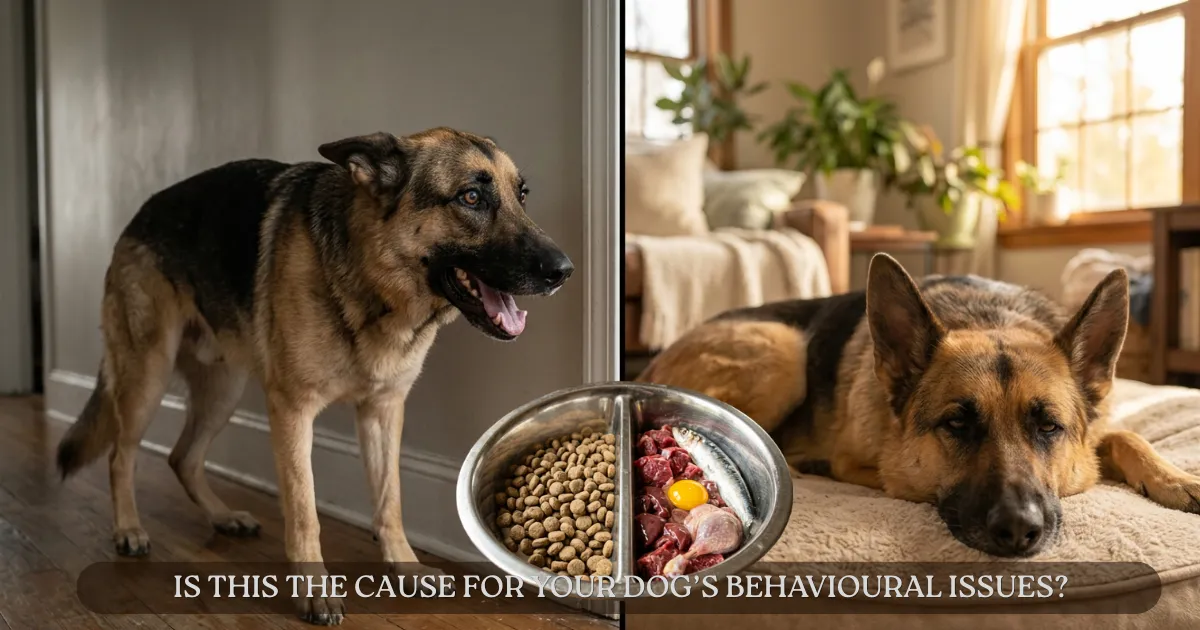
You've tried training classes. You've tried calming supplements. You've adjusted routines, added enrichment, and maybe even consulted a behaviorist. But your dog is still anxious. Still reactive. Still not quite themselves.
What if the answer isn't in their training — but in their food bowl?
Emerging research is revealing a connection that most pet owners (and many vets) haven't considered: what your dog eats may directly influence how they feel and behave. Not just because of energy levels or hunger — but through a biological pathway called the gut-brain axis that links your dog's digestive system to their brain.
The Behavior Signs You Might Be Missing
When we think about food sensitivities in dogs, we think about itching, ear infections, and digestive upset. But food-related inflammation doesn't stop at the skin and gut. Some dogs may show behavioral changes that nobody connects to diet:
- Increased anxiety — restlessness, panting, following you from room to room
- Irritability or reactivity — snapping, growling, or overreacting to normal stimuli
- Aggression changes — uncharacteristic resource guarding or leash reactivity
- Disrupted sleep — settling slowly at night, waking frequently
- Low mood or lethargy — withdrawn, less playful, less engaged
These signs are typically attributed to training gaps, stress, or "just their personality." But a growing body of veterinary research suggests that for some dogs, the root may be inflammatory — starting in the gut.
The Science: From Food Bowl to Brain
Here's what the research shows, step by step.
Step 1: Food Sensitivity Triggers Gut Inflammation
When a dog eats something they're sensitive to, it doesn't just cause an itchy reaction on the skin. It damages the intestinal lining.
A 2024 study in Veterinary Medicine and Science found that dogs with atopic dermatitis had significantly elevated biomarkers of intestinal damage — their gut lining was actively compromised (Ekici & Ok 2024). This condition, sometimes called "leaky gut," means the intestinal barrier isn't working properly.
Food-responsive enteropathy — a condition where food sensitivities cause chronic gut inflammation — accounts for an estimated 50–65% of all chronic inflammatory bowel cases in dogs (Jergens & Heilmann 2022).
Step 2: Gut Inflammation Disrupts the Microbiome
A healthy gut contains trillions of bacteria that work in balance. When chronic inflammation takes hold, that balance shifts — a state called dysbiosis.
Research from the Texas A&M Gastrointestinal Laboratory has documented how chronic GI inflammation leads to measurable dysbiosis, reducing the populations of beneficial bacteria that produce short-chain fatty acids (SCFAs) — compounds essential for gut barrier integrity and, critically, for brain health (Pilla & Suchodolski 2021).
The result is a self-reinforcing cycle: inflammation causes dysbiosis, which weakens the gut barrier, which allows more inflammation. Once triggered by a food sensitivity, this cycle can perpetuate itself.
Step 3: Dysbiosis Correlates with Anxiety and Aggression
This is where the research gets remarkable.
A 2025 study published in Scientific Reports found that gut microbiota composition could actually predict whether companion dogs fell into high-anxiety/aggression or low-anxiety/aggression groups. The genus Blautia was consistently identified as linked to anxiety across multiple analyses (Pellowe et al. 2025).
Earlier research found that aggressive pit bull type dogs had distinctly different gut microbiomes from non-aggressive dogs of the same breed (p = 0.035) (Kirchoff et al. 2019). A separate study found that aggressive dogs had unique microbial signatures enriched in Catenibacterium and Megamonas, while phobic dogs showed different patterns entirely (Mondo et al. 2020).
Step 4: The Mechanism — Serotonin Starts in the Gut
How does gut bacteria influence the brain? Through neurotransmitters.
More than 90% of your dog's total body serotonin is produced in the gut — not the brain (Kielbik & Witkowska-Pilaszewicz 2024). When microbial populations shift due to dysbiosis, neurotransmitter production changes. Specifically:
- Dysbiosis reduces serotonin availability — and aggressive dogs have been found to have significantly lower serum serotonin than non-aggressive dogs
- SCFAs produced by beneficial gut bacteria can cross the blood-brain barrier and help regulate the stress response
- Dysbiosis promotes pro-inflammatory cytokines associated with anxiety disorders (Sacoor et al. 2024)
In simple terms: when the gut is inflamed, the brain's chemical balance may shift too.
Step 5: Interventions Work
The most compelling evidence comes from intervention studies showing that changing the gut changes behavior.
A 2025 randomized, placebo-controlled trial — the gold standard of research — gave 40 dogs a probiotic (LP815) for four weeks. The results were significant: probiotic dogs scored measurably less anxious (p = 0.022) and less aggressive (p = 0.015) compared to placebo dogs. Objective activity monitors confirmed faster settling after owner departure and improved sleep consistency (Bijaoui et al. 2025).
A separate study found that the probiotic PS128 reduced aggression and separation anxiety in dogs while decreasing serotonin turnover — directly demonstrating the gut-to-neurotransmitter-to-behavior pathway (Yeh et al. 2022).
And when dogs with food-responsive enteropathy — chronic gut inflammation driven by dietary triggers — were placed on elimination diets, clinical signs resolved or significantly improved within 2–4 weeks of starting the diet (Jergens & Heilmann 2022).
Why This Gets Missed
If the connection between food and behavior is supported by research, why don't more vets discuss it?
- Behavioral issues and dietary issues are typically treated by different specialists. Veterinary behaviorists focus on training and medication. Veterinary dermatologists focus on skin and diet. The gut-brain connection sits between these specialties.
- Delayed reactions make connections invisible. Food sensitivity reactions in dogs can take 24–72 hours for acute onset, and cumulative effects may build over days or weeks. By the time your dog is acting anxious, you're not thinking about what they ate three days ago.
- The field is still emerging. A 2025 critical review in Applied Animal Behaviour Science notes that while the evidence is compelling, the field is "relatively immature" with limited replication across studies. This means your vet may not yet be familiar with the latest research.
This doesn't make the science wrong — it means we're in the early stages of a significant shift in understanding. And it means tracking data becomes even more valuable.
What You Can Do — A Practical Guide
If you suspect your dog's behavior might have a dietary component, here are concrete steps:
1. Start Tracking Food AND Behavior Together
Most pet owners who track food only log meals and skin symptoms. Adding a daily behavior note — even a simple anxiety/energy/mood rating — creates the data that makes patterns visible.
Track consistently for at least 2–4 weeks. Look for correlations between specific foods and behavioral shifts, keeping in mind that reactions may be delayed by days.
2. Consider an Elimination Diet
An elimination diet removes potential trigger proteins and simplifies the diet to a single novel protein source. Research shows most dogs with food-responsive conditions improve within 2–4 weeks (Jergens & Heilmann 2022).
Watch behavior alongside skin and gut symptoms. If your dog becomes calmer, sleeps better, or is less reactive on the elimination diet, that's meaningful data — especially if symptoms return during food challenges.
3. Discuss Probiotics with Your Vet
The probiotic research is promising. While we can't recommend specific strains without veterinary guidance, the evidence that targeted probiotics can reduce anxiety and aggression in dogs is growing stronger with each new study.
4. Share Your Tracking Data with Your Vet
A food-and-behavior log isn't just for you. It gives your veterinarian objective data to work with — patterns they couldn't see in a 15-minute appointment. Many vets who might not discuss the gut-brain axis will still appreciate having detailed tracking data that shows clear food-behavior correlations.
An Important Note on What This Means
This research doesn't mean every anxious or aggressive dog has a food problem. Behavior is complex, and genetics, training, socialization, medical conditions, and environment all play important roles.
What the science does suggest is that food is one piece of the behavioral puzzle — a piece that's often overlooked. For dogs with unresolved behavioral issues alongside dietary sensitivities, investigating the food connection may be worth exploring with your veterinarian.
Always consult your veterinarian before making dietary changes, especially if your dog has behavioral issues that could pose safety concerns. Dietary changes complement but do not replace professional behavioral assessment and training.
References
- Bijaoui et al. 2025. "LP815 probiotic and canine behavior." Animals, 15(15):2280.
- Ekici & Ok 2024. "Intestinal biomarkers in atopic dogs." Veterinary Medicine and Science, 10(3):e1453.
- Jergens & Heilmann 2022. "Food-responsive enteropathy in dogs." Frontiers in Veterinary Science, 9:923013.
- Kielbik & Witkowska-Pilaszewicz 2024. "Serotonin and canine behavior." Animals, 14(14):2048.
- Kirchoff et al. 2019. "Gut microbiome in aggressive dogs." PeerJ, 7:e6103.
- Mondo et al. 2020. "Gut microbiome of aggressive and phobic dogs." Heliyon, 6(1):e03311.
- Pellowe et al. 2025. "Gut microbiota and anxiety/aggression scores." Scientific Reports, 15:24336.
- Pilla & Suchodolski 2021. "Gut microbiome and metabolome." Veterinary Clinics of North America, 51(3):605-621.
- Sacoor et al. 2024. "Gut-brain axis and canine anxiety." Veterinary Medicine International, 2024:2856759.
- Yeh et al. 2022. "PS128 probiotic and dog behavior." Applied Animal Behaviour Science, 247:105569.
Disclaimer: This article is for educational purposes only and does not constitute veterinary advice. Always consult with a qualified veterinarian before changing your dog's diet or discontinuing any prescribed treatments. Persistent symptoms can have multiple causes, some of which require specific veterinary treatment.
Related Articles
Dog Food Allergy vs. Food Sensitivity: What's the Real Difference?
Your dog is itching and your vet mentioned food allergy. Learn the real difference between food allergy, sensitivity, and intolerance in dogs — and why it matters for diagnosis.
Read Article →
Your Dog's Elimination Diet Is Useless Without This One Step
Without consistent tracking, even the best elimination diet becomes a guessing game. Learn why tracking is essential for identifying your dog's food sensitivities.
Read Article →
Food Sensitivities in Pets: Uncovering the Hidden Culprits Behind Common Symptoms
Understanding food sensitivities vs. allergies in pets. Learn about symptoms like itchiness, IBD, yeast infections, and how elimination diets can help identify triggers.
Read Article →